• About
  • Content Organized by Life-Style Choices

Purposely Live to120

~ Living to the full potential life-span with full vigor

Category Archives: Optimal Health

Post #35 – What is Optimal Health? Some observations from my ski vacation.

01 Sunday Mar 2015

Posted by purposelyliveto120 in Optimal Health, Puposely Living

≈ Leave a comment

Tags

Biomarkers, Health Span

Two weeks ago, I took a vacation to go skiing with my son Justin in Colorado. We skied (actually I ski, Justin snow boards) in Breckenridge, Keystone and Vail. On the first day snow conditions were okay for Colorado. But during the next two days, it snowed and with the fresh snow the conditions were great.

Every once in a while, I would stop in the middle of my skiing to check up on my body, admire the mountains and the vistas all around me, to express my gratitude, or to be simply mindful of  the phenomenal opportunity I had to be there.

I was very happy with my body. It was providing me all the energy, endurance, strength, balance, quickness and flexibility that I needed to be able to enjoy the slopes. And, on top of that I was able to push myself just to improve my skills by attempting some challenging expert trails.

I did take a few spills too. With the flexibility and quick reflexes that my body afforded me, the spills were uneventful.

Throughout our time on the slopes, Justin kept saying, “Come on dad, lets do what we came here to do.”  And, that led me to the following thought.

Justin Snowboarding

Justin Snowboarding

Me Skiing

Me Skiing

In the previous posts on this blog, I have talked about how Bio Markers are used to define Optimal Health. Reflecting upon the ski experience, I thought a good “clinical” way of defining Optimal Health beyond the Bio Markers was simply “having the ability to do what one wants to do”.

On a typical day, it could simply be the energy you need from when you wake up in the morning until the end of the day. Or, as I often like to say, “Optimal Health is to run out of the day before you run out of energy”.

But through the ski vacation, it is clear that what we need is more than the energy. Isn’t it?

So, for Optimal Health, in addition to Energy, we also need:

Endurance – to be able to go the distance, when we need it. Not all days are equal.

Strength – to conduct whatever our work or play requires

Flexibility – some say that flexibility is the real power or strength

Balance – the stories abound over the last two weeks of slips and slides on the ice and snow

Quick Reflexes – we require quick reaction times to adapt to the circumstance

So, Optimal Health for me is not only all bodily systems working well without any fuss or muss, but also having sufficient Energy, Strength, Endurance, Flexibility, Balance and Quick Reflexes that matches your lifestyle.

How do you define Optimal Health?

I would love to hear from you.

Please feel free to leave your comments or questions to this post, so others can participate, share and learn.

Post #33 – What can you do to maintain optimal health of your brain? Or, How my sons got me playing video games?

18 Sunday Jan 2015

Posted by purposelyliveto120 in Aging, Living to 120, Mental Health, Optimal Health, Vitality

≈ 2 Comments

Tags

Aging, Chronic Disease, Lifestyle, Mental Health

In most of my past blogs, I have talked about maintaining optimal physical health – staying physically fit, keeping all chronic diseases such as diabetes, arthritis, high blood pressure, cardiovascular issues and such at bay. Also, I have talked about developing, building and maintaining lean mass, strength, balance and flexibility.

But, what about the brain? How to keep brain in top shape as we age, while keeping Alzheimer disease and dementia far away from ourselves? What is in our control that we can do?

After all, living to 120 (or to whatever your target is), without full cognitive faculties won’t be much fun.

Researching this topic, I found that National Institute of Health (NIH), National Institute of Aging, has a very good chapter “The Changing Brain in Healthy Aging” in their publication “Alzheimer’s Disease: Unraveling the Mystery”. The following is excerpt from that chapter.

As a person gets older, changes occur in all parts of the body, including the brain:

  • Certain parts of the brain shrink, especially, the prefrontal cortex (an area at the front of the frontal lobe) and the hippocampus. Both areas are important to learning, memory, planning, and other complex mental activities.
  • ­Changes in neurons and neurotransmitters affect communication between neurons. In certain brain regions, communication between neurons can be reduced because white matter (myelin covered axons) is degraded or lost.
  • ­Changes in the brain’s blood vessels occur. Blood flow can be reduced because arteries narrow and less growth of new capillaries occurs.
  • ­In some people, structures called plaques and tangles develop outside of and inside neurons, respectively, although in much smaller amounts than in Alzheimer Disease
  • ­Damage by free radicals increases – free radicals are a kind of molecule that reacts easily with other molecules­
  • Inflammation increases  – inflammation is the complex process that occurs when the body responds to an injury, disease, or abnormal situation.

What effects does aging have on mental function in healthy older people?

Some people may notice a modest decline in their ability to learn new things and retrieve information, such as remembering names. ­They may perform worse on complex tasks of attention, learning, and memory than would a younger person.

However, if given enough time to perform the task, the scores of healthy people in their 70s and 80s are often similar to those of young adults. In fact, as they age, adults often improve in other cognitive areas, such as vocabulary and other forms of verbal knowledge.

It also appears that additional brain regions can be activated in older adults during cognitive tasks, such as taking a memory test. Researchers do not fully understand why this happens, but one idea is that the brain engages mechanisms to compensate for difficulties that certain regions may be having.

For example, the brain may recruit alternate brain networks in order to perform a task. Th­ese findings have led many scientists to believe that major declines in mental abilities are not inevitable as people age. Growing evidence of the adaptive (what scientists call “plastic”) capabilities of the older brain provide hope that people may be able to do things to sustain good brain function as they age. A variety of interacting factors, such as lifestyle, overall health, environment, and genetics also may play a role.

Another question that scientists are asking is why some people remain cognitively healthy as they get older while others develop cognitive impairment or dementia. Th­e concept of “cognitive reserve” may provide some insights.

Cognitive reserve refers to the brain’s ability to operate effectively even when some function is disrupted. It also refers to the amount of damage that the brain can sustain before changes in cognition are evident. People vary in the cognitive reserve they have, and this variability may be because of differences in genetics, education, occupation, lifestyle, leisure activities, or other life experiences.

Th­ese factors could provide a certain amount of tolerance and ability to adapt to change and damage that occurs during aging. At some point, depending on a person’s cognitive reserve and unique mix of genetics, environment, and life experiences, the balance may tip in favor of a disease process that will ultimately lead to dementia.

For another person, with a different reserve and a different mix of genetics, environment, and life experiences, the balance may result in no apparent decline in cognitive function with age.

Scientists are increasingly interested in the influence of all these factors on brain health, and studies are revealing some clues about actions people can take that may help preserve healthy brain aging. Fortunately, these actions also benefit a person’s overall health. Th­ey include:

  1. ­Controlling risk factors for chronic disease, such as heart disease and diabetes (for example, keeping blood cholesterol and blood pressure at healthy levels and maintaining a healthy weight) ­
  2. Enjoying regular exercise and physical activity ­
  3. Eating a healthy diet that includes plenty of vegetables and fruits
  4. ­Engaging in intellectually stimulating activities, and
  5. Maintaining close social ties with family, friends, and community

So, actions 1, 2 and 3 suggested by NIH NIA are the same as for keeping physical body fit and in good order. That is a good news!

But there are also additional actions 4 and 5 one can take, that are good to keep brain fit and in good order.

Piano Lessons at 60:

To increase my intellectually stimulating activities, as I was turning 60, I decided to start taking piano lessons. I have been very left brain focused on my intellectual pursuits – STEM or Science Technology, Engineering and Math education. So, I figured, it is high time I did something to develop my underused right brain. And, there is a lot of evidence in research of the benefits of learning music on the brain.

For the last six months, I have been finding piano lessons very pleasurable and at the same time very intellectually and physically demanding. One half-hour lesson a week and daily practice of half hour to an hour, is what it takes for me learn and get comfortable with a piano piece my teacher introduces in the lesson. Initially it was just one piece from the “techniques book”, for the last few weeks, there is an additional piece from a popular “songs book”. All this piano playing got be doing something good for my brain, since week after week, it seems that I am learning with my brain and in my muscles new stuff.

How my sons got me playing video games:

Until now, I have completely resisted playing video games.

For Christmas, our twin sons, Daniel and Justin, gave us a present of family membership to Lumosity. Lumosity exploits research to-date in neuroplasticity. Research has found that certain types of activities may impact the brain more than others. It’s believed that as an activity is repeated, the brain tends to fall back on the same set of existing neural pathways. To continue changing, the brain must be exposed to novel, adaptive experiences that challenge it to work in new ways.

Drawing on this idea, Lumosity is designed to give each person a set of exercises that challenge their cognitive abilities.

Lumosity “games” are based on a combination of common neuropsychological and cognitive tasks, many of which have been used in research for decades, and new tasks designed by an in-house science team. Working with experienced game designers, Lumosity neuroscientists have transformed these tasks into over 40 challenging, adaptive games.

Lumosity’s game-based training program is designed to expose your brain to gradually increasing levels of challenges, adapting game difficulty to your individual ability level. As your scores increase, you may encounter new or more difficult games. Modeled from the concept of a physical personal trainer, Lumosity pushes you to operate at the limits of your abilities and stay challenged.

They also report measures of your performance, so you can see how you are improving in speed, memory, attention, flexibility and problem solving and how you compare with others in your age bracket. A metric called LPI is a consolidated metric of these five factors. Also, you can use a test called Baseline Test to see how the scores translate to other situations you don’t play in the games.

I have been playing these games for two weeks now. It is definitely fascinating, how various skills of speed, memory, attention, flexibility and problem solving improving. With this rate of progress, who knows, I may get good enough to play some video games against Justin and Daniel!

What are your thoughts on this subject of keeping brain fit and in optimal shape?

What strategies or techniques do you use to keep you brain fit?

Please leave a comment in the blog; I would love to hear from you.

Post #31 – What supplements to take for Optimal Health?

04 Sunday Jan 2015

Posted by purposelyliveto120 in Functional Medicine, Nutrition, Optimal Health, Optimal Nutrition, Supplements

≈ Leave a comment

Tags

Allergies, Cholesterol, optimal health, Optimal Nutrition, Preventative Care, Supplements

On June 8, 2014, I wrote a blog post #15, “Is taking multivitamin and supplements helpful, harmless or harmful?” There I described my thinking on this subject and what I was taking at that time as supplements. Back then I was taking supplement in 29 pills. These days, it is up to 42 pills! So, to anyone watching, it must feel a little more than crazy.

Over the holidays, when family and friends saw me take all those supplement pills, I kept getting these questions:

“What are all these pills you are taking?”

Do you need all these supplements?

Is it even safe to take all these on a daily basis?

Finally, I pulled out my bag of supplements and gave them the full tour. I particularly wanted to hear my niece’s opinion, who is a cardiologist, to understand if I was doing anything wrong.

So, I thought this was a good topic to revisit.

Here is what I am taking these days and why, and a little background how I got there. The following chart summarizes the supplements, their brand names and generally what there are for.

No. Vendor Name Description # Pills per Day
1.


Xtendlife Total Balance Men’s Premium Daily multivitamins, minerals. It also have many other items generally considered beneficial 7
2. Xtendlife Omega 3/ QH Ultra Fish Oil, Omega 6, Omega 9, Ubiqunol 4
3. Nature’s Bounty Flaxseed Oil 1200 mg each Flaxseed Oil 2
4. Nature’s Bounty D3-2000 2000 mg each Vitamin D3 2
5. LifeExtension Glucosamine / Chondroitin Glucosamine Sulfate and Chondroitin Sulfate – for joint health 2
6. NOW Calcium Citrate

250 mg calcium each

Along with Vitamin D, Manganese, Zinc, Copper and Magnesium required for absorption – for bone health 2
7. Nature’s Plus Red Rice Yeast

600 mg each

To manage cholesterol 2
8. Xtendlife Male Rejuvinator For prostate health 6
9. Life Extension Super Miaforte For Low T 4
10. RAW Probiotics Ultimate Care-100 Billion Garden of Life 34 different strains of bacteria 1
11. VitaminShoppe B-Complex 50 All B Vitamins – recommended by Genova Diagnostics 1
12. Life Extension Optimized Folate

L-Methylfolate 1000 mg

Metabolically active form of folic acid -– recommended by Genova Diagnostics 1
13. MethylCobamin Vitamin B-12 1mg Recommended by Genova Diagnostics 1
14. SOLGRID Chelated Molybdenum Recommended by Genova Diagnostics 1
15. VitaminShoppe Alpha Lipoic Acid 100 mg Recommended by Genova Diagnostics 1
16. KAL Magnesium 400mg each Recommended by Genova Diagnostics 1
17. VitaminShoppe CoQ-10

200 mg

Additional amount for allergies and liver support 1
18. VitaminShoppe NAC N-Acetyl-L-Cysteine 600mg For hay fever/ rag weed allergies and liver support 2
19. VitaminShoppe Milk Thistle extract 300mg For hay fever/ rag weed allergies and liver support 1

Here is the story of how I got to my current 42 pills a day regime.

I started with the daily multivitamin.

That is the most basic. I know that many people, including some of the physicians I have had, believe that it is best to get the basic vitamins and minerals “in a natural way”. I guess that means from what we eat or drink. But doing the research on this topic I have decided that there isn’t much “natural” about our lifestyle.

Eating foods that include pizzas, fried ice creams, drinking caramel macchiatos, going through eating and dieting binges, living in temperature controlled houses and offices, using gadgets and gizmos for everything, rushing to doctors for prescription for every symptom, I am not sure what it really means to get nutrients that body needs in a “natural way”. And, with all the technology that we use to grow our food these days, even fruits and vegetable can hardly be called “natural”.

Any doctor will tell you, yes if you are deficit in any of the basic vitamins and minerals, you can develop health issues. The way I look at it, why would I want to chance having deficit of any of these essential items? So, as far as I am concerned, daily dose of all essential vitamins and minerals is a must.

My search for the best multivitamin in the marketplace led me to Xtendlife. And, as you can see in this table below, their super-duper multivitamin product is Total Balance Men’s Premium – which includes lots of other well-known herbs and molecules in additional to the essential vitamins and minerals. So, that is what I have been taking. In the table, each underscored item is a hyperlink to the detail about that item on Xtendlife’s website. In many cases, hyperlink shows the literature they have used to determine the daily optimal dose, which in some cases you will notice is much more than 100% for USDA recommended daily allowance (RDA).

Supplement Facts (Total Balance Men’s Premium multivitamin) Serving size: 7 Tablets Servings per container: 15
Amount Per Serving % Daily Value*
Calories 25
     Calories from fat 5
Vitamin A 5000 IU 100%
(from Natural mixed carotenoids)
Vitamin C 285 mg 480%
(from 180 mg of Calcium ascorbate, 200 mg of Potassium ascorbate and 40 mg of  Ascorbyl palmitate)
Vitamin D3 500 IU 130%
(as Cholecalciferol)
Vitamin E 100 IU 330%
(as D-Alpha tocopheryl succinate from vegetable and soy bean oils 1 mg = 1.21 IU)
Vitamin K2 180 mcg 230%
(as Menaquinone)
Thiamin 10 mg 670%
(from 14 mg of Thiamin hydrochloride)
Riboflavin 10 mg 590%
(from 21 mg of Riboflavin-5-phosphate)
Niacin 27 mg 140%
(from 15 mg of Nicotinic acid, 15 mg of Niacinamide and 0.97 mg Chromium nicotinate)
Vitamin B6  8mg 400%
(from 12 mg of Pyridoxal-5-phosphate)
Folic Acid 300 mcg 80%
Vitamin B12  25 mcg 420%
(as Cobamamide)
Biotin 400 mcg 130%
Pantothenic acid 41 mg 410%
(from 48 mg Calcium pantothenate)
Calcium 50 mg 6%
(from 90 mg of Dicalcium phosphate, 180 mg of Calcium ascorbate, 60 mg of Calcium magnesium inositol hexaphosphate and 48 mg of Calcium pantothenate)
Phosphorus 28 mg 4%
(from 90 mg of Dicalcium phosphate, 60 mg of Calcium magnesium inositol hexaphosphate, 21 mg of  Riboflavin- 5-phosphate and 12 mg of Pyridoxal- 5-phosphate)
Iodine 150 mcg 100%
(from 197 mcg Potassium iodide)
Magnesium 67 mg 20%
(from 200 mg of Magnesium citrate, 102 mg of Magnesium stearate and 60 mg of Calcium magnesium inositol hexaphosphate)
Zinc 19 mg 130%
(from 33 mg of Zinc acetate dihydrate and 31 mg of Zinc citrate)
Selenium 100 mcg 140%
(from 250 mcg of L-selenomethionine)
Copper 0.2 mg 10%
(from 1.43 mg of Copper gluconate)
Manganese 2 mg 100%
(from 8 mg of Manganese citrate)
Chromium 106 mcg 90%
(from 970 mcg of Chromium nicotinate)
Molybdenum 64 mcg 90%
(from 163 mcg of Sodium molybdate)
Potassium 74 mg 2%
(from 200 mg of Potassium ascorbate, 100 mg of Tripotassium citrate and 0.197 mg of Potassium iodide)
RNA 150 mg **
(Ribonucleic acid, from yeast)
Green tea extract 100 mg **
(from Camellia sinensis, leaf)
(providing 80 mg of catechins)
Milk thistle extract  100 mg **
(from Silybum marianum, seed)
(providing 80 mg of silymarins)
Soy lecithin 100 mg **
(a source of Phosphatidyl choline)
Betain HCL 99 mg **
MSM 99 mg **
(Methylsulfonyl methane)
Choline bitartrate 93 mg **
DMG HCL 90 mg **
N-acetyl glucosamine  79 mg **
(from Crustacean shells)
Hesperidin 78 mg **
(from Citrus aurantium (Bitter orange) fruit)
N-acetyl L-cysteine 74 mg **
Horsetail extract 60 mg **
(from Equisetum arvense, stem & leaf)
Inositol 59 mg **
(from 50 mg of Inositol and 60 mg of Calcium magnesium inositol hexaphosphate)
SAMe 51 mg **
(from 98 mg S-adenosylmethionine tosylate)
Alpha lipoic acid 50 mg **
Bacopa extract 50 mg **
(from Bacopa monnieri, leaf)
(providing 15 mg of bacosides)
Black cumin extract  50 mg **
(from Nigella sativa, seed)
(equivalent to 190 mg of Black cumin seeds)
Ginger extract 50 mg **
(from Zingiber officinale, root)
(providing 2.5mg of gingerols)
Ginkgo extract 50 mg **
(from Ginkgo Biloba,leaf)
(providing 12.5 mg of ginkgo flavonoglycosides and 3 mg of terpene lactones)
Guggul gum extract 50 mg **
(from Commiphora mukul, gum exudate)
(providing 1.25 mg of guggulsterones)
PABA 50 mg **
(p-Aminobenzoic acid)
Pine bark extract  50 mg **
(from Pinus massoniana, bark)
Turmeric extract 50 mg **
(from Curcuma longa, root)
(providing 47.5 mg of curcuminoids)
5-Hydroxytryptophan  49 mg **
(from Griffonia simplicifolia, seed)
Myricetin 49 mg **
(from 70 mg of Myrica cerifera (Bayberry), leaf)
Grape seed extract  30 mg **
(from Vitis vinifera, species)
(providing at least 450 mg/g phenolics)
Mineral sea salts 30 mg **
(providing trace elements including strontium, tungsten and rubidium)
Piperine 28 mg **
(from 30 mg of Piper nigrum extract (Black pepper), fruit extract)
Trans-resveratrol 25 mg **
(from 50 mg of Japanese knotweed (Polygonum cuspidatum), root)
Isoflavones 20 mg **
(from 50 mg of Soybean extract)
Coenzyme Q-10  19 mg **
Luteolin 18 mg **
(from Arachis hypogaea (Peanut), shell)
Alfalfa extract  10 mg **
(from Medicago sativa, aerial parts)
(equivalent to 110 mg of fresh alfalfa)
Phosphatidyl L-serine  9 mg **
(from 50 mg of Soybean lecithin)
Policosanol 8 mg **
(from 17 mg of Sugar cane extract)
Red clover extract  7 mg **
(from Trifolium pratense, aerial parts)
(providing 2.5 mg of isoflavones)
ATP 5 mg **
(Adenosine triphosphate, from Yeast)
Tocotrienol/tocopherol complex 2 mg **
(from 10 mg of Tocomin® (from Palm tree oil))
Vinpocetine 2 mg **
(from Criocerus longiflorus, whole plant)
Boron 720 mcg **
(from 12 mg of Boron citrate)
Amino Acid Blend
L-lysine HCL 164.00 mg **
L-carnosine 148.50 mg **
L-tyrosine 100.00 mg **
L-arginine HCL 90.00 mg **
L-methionine 89.55 mg **
L-ornithine HCL 50.00 mg **
L-proline 50.00 mg **
L-cysteine 49.75 mg **
L-glutamine 49.75 mg **
L-pyroglutamic acid 49.75 mg **
Taurine 49.25 mg **
(Reduced) L-glutathione 49.00 mg **
Male Health Support Blend
Phytosterols 190 mg **
(from 200 mg Soybean extract)
Saw palmetto extract  160 mg **
(from Serenoa repens fruit)
(providing 40 mg of fatty acids)
Nettle extract 100 mg **
(from Urticae dioica root)
Chrysin 99 mg **
(from Oroxylum indicum bark)
Zinc acetate dihydrate 33 mg **
Lycopene 99 mcg **
(from 15 mg of Tomato extract)
Enzyme Blend
Bromelain 50 mg **
(from Pineapple stem)
Nattozimes® 50 mg **
(Protease from fermentation of Aspergillus oryzae & Aspergillus melleus)
Amylase 30 mg **
(from fermentation of Aspergillus oryzae)
Lipase 20 mg **
(from fermentation of Aspergillus niger)
Immunity Stimulating Blend
Aloe vera  50 mg **
(from Aloe barbadensis leaf juice powder)
(equivalent to 10,000 mg of Aloe leaf juice)
Olive leaf extract  50 mg **
(from Olea europaea, leaf)
(providing 7.5 mg of oleuropein)
Beta glucan 35 mg **
(from yeast)
Tea polysaccharides 12 mg **
(from 50 mg of Camellia sinensis leaf)
Eye Health Blend
Bilberry extract 40 mg **
(from Vaccinum myrtillus fruit)
(providing 10 mg of proanthocyanins and anthocyanins)
Rutin  9 mg **
(from Saphorae japonica bud)
Lutein  2.4 mg **
(from 50 mg of Aztec marigold flower)
Astaxanthin 800 mcg **
(from 40 mg of Haematococcus pluvialis)
Zeaxanthin 475 mcg **
(from 10 mg of Aztec marigold flower)

I had started taking Vitamin D-3, several years ago, when my routine blood work showed deficiency. Statistics show that over 70% of people living in Northern hemisphere are deficient in Vitamin D-3. There are over 500 different genes that Vitamin D can switch on and off. And, every single cell in our body has a receptor for Vitamin D. Looks like a must supplement to me! Two pills a day of Nature’s bounty 2000mg per day is the dose I have chosen.

Next must for me after the multivitamins and Vitamin D is Omega 3. I have been taking both based on Fish Oil and Flax Seed Oil. Again, I found Xtendlife Omega 3 as the best product in the market. I have chosen to take to their super-duper product, Ultra QH, which in additional to Omega 3, contains Omega 6, Omega 9 and Ubiqunol. For flax seed oil, I selected Nature’s Bounty product. There are different recommendations on minimum vs. optimal. I have settled on four pills of Ultra QH and 2 pills of flax seed oil.

To these I added Glucosamine Sulfate and Chondroitin Sulfate for joint health. Most primary physicians are recommending these for over-50 patients for joint health. Add to that Calcium Citrate for bone health (again physicians recommend these routinely for over-50 patients, especially women).

When I told my physician that I wanted to get off Lipitor and demonstrated to him that with exercise and nutrition I had gotten to within striking range of the target of 100 for LDL, he recommended Red Rice Yeast as “natural statin”. In the last two tests, my LDL has been 90 and 88. So, I am keeping on with Red Rice yeast.

My primary physician had recommended Saw Palmetto for prostate health. I found a good formulation, at VitaminShoppe of Saw Palmetto & Pygeum Complex. That worked well for me. Then I found even a better formulation, Male Rejuvinator at Xtendlife.

Early last year, I did a full hormone panel of tests and found that my Testosterone was quite low. In my search for supplements to rebuild Testosterone, I came across a formulation called Super Miaforte from Life Extension. I have been taking Super Miaforte for about nine months now. Follow up test results for Testosterone have been very encouraging so far.

So, in the middle of last year, I made an appointment with University of Maryland Medical Center, School of Integrative Medicine clinic. There I met with Dr. Lauren Richter, a functional medicine specialist. I told her my objective of purposely living to 120, discussed my lifestyle, showed her all the supplements I was taking and posed to her this question: So, what supplement should I take for an optimal health?

Instead of looking at me cross-eyed, she said that she (and functional medicine specialists) has a very specific approach to figuring out the optimal nutrition in-take. She recommended that I go through blood/urine test called NutrEval FMV by Genova Diagnostics. The tests involve looking at a large number of metabolic biomarkers, and then as a result, deducing very specific recommendations about supplements for optimal health.

Test results pointed out high need for me for the entire B-complex (Thimain -B1, Riboflavin -B2, Niacin-B3, Pyridxine-B6, Biotin-B7, Folic Acid -B9, and Cobalamin-B12), Magnesium and need for me to add Vitamin C, alpha-Lipoic Acid, Molybdenum and Zinc and Probiotics to what I was already taking. Results contained very specific quantities for these. Dr. Richter reviewed what I was already taking and told to me to continue taking those.

Finally, when I discussed with Dr. Richter, my past history of hay fever/allergies, which had re-emerged for a couple of weeks at the beginning of this past fall, she recommended I take Milk Thistle, up the quantity of CoQ10 and add N-Acetyl-L-Cysteine (NAC) 600mg –all in support of the liver.

So, at that point, I added these recommended supplements to my regime.

I have been doing this full regime faithfully now for about five months. I definitely have had more energy than before. I have not really experienced any side effects so far.

So, there you have it – full story of my supplement regime.

What do you think?

What is your practice/experience/research on supplements?

I would love to hear.

Post #29 – Eating for Optimal Health Part VIII – Add or subtract specific foods based on your personal needs

29 Saturday Nov 2014

Posted by purposelyliveto120 in Aging, Living to 120, Nutrition, Optimal Health, wellness

≈ 2 Comments

Tags

Aging, Allergies, Chronic Disease, living to 120

In blog post of 9/29/2014: So, what should you eat for optimal health?, I listed the seven basic principles I have extracted from the many diet books and resources I have studied. These principles are:

  1. What you eat, how much you eat and when you eat, all matter
  2. Eat clean
  3. Eat lots of vegetables and fruits
  4. Use only healthy fats and fat sources
  5. Incorporate sufficient proteins in your diet
  6. Best beverage to drink is pure water
  7. Add or subtract specific foods based on your personal needs

In the last posts, we discussed the first six of these principles. Today, in the last blog post of this series, let’s focus on the seventh principle: Add or subtract specific foods based on your personal needs. And, as usual without any fluff stuff, let’s get to it.

Even though we humans all are of the same species, our bodies are quite unique due to genetic and environmental differences that we grew up in. Because of this uniqueness, it is not unreasonable to have unique needs for what we eat to adapt to our bodies.

Western medicine and nutrition framework can recognize these differences only in terms of different caloric needs based on size, food allergies, intolerance and sensitivities.

However, eastern medicine and nutrition frameworks, offer other ways of matching specific foods to specific unique needs of our bodies.

Let’s explore both of these frameworks that we can use to customize what we eat.

Food Allergies, Intolerance and Sensitivities

As Mayo Clinic page on Food Allergy describes: A true food allergy causes an immune system reaction that affects numerous organs in the body. It can cause a range of symptoms. In some cases, an allergic reaction to a food can be severe or life-threatening (anaphylaxis) — even if past reactions have been mild.

If you have any food allergies, it is important to learn how to recognize a severe allergic reaction and know what to do if one occurs. You may need to carry an emergency epinephrine shot (EpiPen, Auvi-Q, others) for emergency self-treatment.

In contrast, food intolerance symptoms are generally less serious and often limited to digestive problems. But these can also be the cause of chronic issues including excess weight, obesity, leaky gut and many other related issues.

Causes of food intolerance include:

  • Absence of an enzyme needed to fully digest a food. Lactose intolerance is a common example.
  • Irritable bowel syndrome. This chronic condition can cause cramping, constipation and diarrhea.
  • Food poisoning. Toxins such as bacteria in spoiled food can cause severe digestive symptoms.
  • Sensitivity to food additives. For example, sulfites used to preserve dried fruit, canned goods and wine can trigger asthma attacks in sensitive people. Mono sodium glutamate (MSG) often used in Chinese cooking can cause digestive issues.
  • Recurring stress or psychological factors. Sometimes the mere thought of a food may make you sick. The reason is not fully understood.
  • Celiac disease. Celiac disease has some features of a true food allergy because it involves the immune system. However, symptoms are mostly gastrointestinal, and people with celiac disease are not at risk of anaphylaxis. This chronic digestive condition is triggered by eating gluten, a protein found in wheat and other grains.

With the recent research in micro biome or gut bacteria, there is mounting evidence that many of the food sensitivities and even food allergies can be cured by improving the gut bacteria.

So, it is important to understand personal food allergies, intolerances and sensitivities. And, then find workarounds or solutions to those.

Here is one quick anecdote on this topic.

Several years ago, often around menstruation time, my wife Kimberly used to have abdominal pains, sometimes quite severe and debilitating. So, we started chasing the issue. Doctors did various tests to diagnose it, but no luck. She even subjected herself to a painful colonoscopy. Radiologist pointed out inflammation at the place where her colon turns. But he could not argue why that would cause issues she had been experiencing. They even started using the “C” word for some stomach cancer, which kind of freaked her out emotionally.

During this time, I started keeping a sort of diary of her lifestyle. I noticed that every time her sister or mother visited us, for the period that followed she would have severe pains. I thought that was rather curious.

You see, ever since, I became vegetarian, she did not eat much meat. We did not cook much meat at home. And, even when we ate out, she generally preferred to share what I would eat, which would be vegetarian fair. But every time her sister or mother would visit, they will have several meals out at the restaurants and she would indulge in lots of meats, especially red meats.

Once I figured this out, I asked her to experiment with keeping meat to minimum and absolutely no red meat for a few months – which she did faithfully. And, lo and behold, her pains went away. She experimented with adding the red meat back, with the result of pains also being back. Having learned that lesson, she has now stuck to the lifestyle of mostly no red meat and pains have been gone.

Eastern medicine and nutrition frameworks

Eastern medicine and nutrition frameworks provide different methods (and some would argue, much more precise methods) of matching foods to a person’s specific needs.

I am most familiar with the Indian Ayuervedic system so I will briefly share that here.

According to Ayurveda, there are three primary body types: Vata, Pitta and Kapha.  These body types are also called Doshas.

We are born with either one of these three, or some combination of these, i.e., Vata-Pitta, Vata-Kapha, Pitta-Kapha or Vata-Pitta-Kapha types.

The primary body types are made up of a combination of five basic elements of nature: Earth, Water, Fire, Wind, and Space.

Earth + Water = Kapha

Fire + Water = Pitta

Wind + Space = Vata

By looking at the nature of the constituent elements, you can probably quickly guess the properties associated with each Dosha or body type.

Kapha person would thus be very “earthy”, heavier musculature, gains weight quickly, has moist or oily skin, likes to stays settled in a place, is slow and steady, is often cold and smooth.

Pitta person would be hot, intense, light, flexible, slightly oily, fluid, sour smelling.

Vata person will have dry skin, be on the move all the time, is often cold, rough adept to change, subtle quick and light.

The theory is that we all have an inherent body type that corresponds to our inborn nature. Eating foods and living lifestyle that take us away from our inherent Doshas cause stresses on our bodies and in turn cause issues. Progressed to advanced stages, these perturbations in the body become clinical symptoms that are discovered as ailments in the context of western medicine.

Foods on the other hand, in Ayurveda, are categorized as sweet, sour, salty, stringent, bitter and pungent. Based on the nature of food, it could either aggravate or pacify a particular body type or Dosha.

Kapha is

  • Balanced by pungent, bitter, astringent, light, dry and hot foods
  • Aggravated by sweet, sour and salty foods, heavy, oily and cold

Pitta is

  • Balanced by bitter, sweet, astringent, cold, heavy and dry foods
  • Aggravated by pungent, sour, salty, hot, light and oily foods

Vata is

  • Balanced by salt, sour, sweet, heavy, oily and hot foods
  • Aggravated by pungent, bitter, astringent, cold, dry, light foods

An Ayuervedic practitioner’s goal is to uncover any differences between inherent body type and the present body type and to recommend foods and lifestyle that will bring the body to the back the inherent body type.

As the body realigns with its inherent Doshas, different types of issues and ailments just recede and disappear.

This,  of course, is a pretty deep topic by itself.

“Perfect Health – A complete mind body guide”, a book by Deepak Chopra, M.D., is a very accessible book that explains these Ayuervedic principles and practices. Based on the Ayuervedic theory, the book offers very practical means for matching foods to one’s specific needs and/or make adjustments if you feel any “stresses” in your body.

What do you think of this approach?

Do you feel that this provides guidance on how to adjust your diet to match your personal needs?

Do you see a hole in this approach? What would you do differently?

Post #28 – Eating for Optimal Health Part VII – Best beverage to drink is pure water

16 Sunday Nov 2014

Posted by purposelyliveto120 in Ideal Body Weight, Lean Mass, Life-Span, Living to 120, meditation, Nutrition, Optimal Health, Optimal Nutrition, Reversing Chronic Diseases, Vitality

≈ 3 Comments

Tags

Chronic Disease, Headache, Live to 120

In blog post of 9/29/2014: So, what should you eat for optimal health?, I listed the seven basic principles I have extracted from the many diet books and resources I have studied. These principles are:

  1. What you eat, how much you eat and when you eat, all matter
  2. Eat clean
  3. Eat lots of vegetables and fruits
  4. Use only healthy fats and fat sources
  5. Incorporate sufficient proteins in your diet
  6. Best beverage to drink is pure water
  7. Add or subtract specific foods based on your personal needs

In the last posts, we discussed the first five of these principles. Today, let’s focus on the fifth principle: Best beverage to drink is pure water. And, as usual without any fluff stuff, let’s get to it.

I am sure by now you have heard over and over again, “Keep yourself hydrated.” Or “Drink plenty of water”. But why do we need to keep hydrated?

Water is the solvent for biochemical reactions and has unique physical properties (e.g., high specific heat) to absorb metabolic heat within the body.

Water is also essential for maintaining vascular volume and serves as the medium for transport within the body by supplying nutrients and removing waste. In addition, cell hydration has been has been suggested to be an important signal to regulate cell metabolism and gene expression.

Water is the largest component of human bodies. About 70% of our body weight is water. To maintain homeostasis, i.e., equilibrium in our biology, we need to replenish the daily water loss. Water loss comes from breathing out, sweating, urination and excretion.

You may have noticed feeling sluggish if you are dehydrated. In fact dehydration can bring on a variety of symptoms:

Mild to moderate dehydration is likely to cause:

  • Dry, sticky mouth
  • Sleepiness or tiredness — children are likely to be less active than usual
  • Thirst
  • Decreased urine output
  • No wet diapers for three hours for infants
  • Few or no tears when crying
  • Dry skin
  • Headache
  • Constipation
  • Dizziness or lightheadedness

Severe dehydration, a medical emergency, can cause:

  • Extreme thirst
  • Extreme fussiness or sleepiness in infants and children; irritability and confusion in adults
  • Very dry mouth, skin and mucous membranes
  • Little or no urination — any urine that is produced will be darker than normal
  • Sunken eyes
  • Shriveled and dry skin that lacks elasticity and doesn’t “bounce back” when pinched into a fold
  • In infants, sunken fontanels — the soft spots on the top of a baby’s head
  • Low blood pressure
  • Rapid heartbeat
  • Rapid breathing
  • No tears when crying
  • Fever
  • In the most serious cases, delirium or unconsciousness

Many diseases are linked to dehydration. These include kidney stones, gall stones, bladder, colon and other cancers, arrhythmias, blood clots, Mitral Valve Prolapse, and Osteoporosis.

How much water do we need?

So, given that we need to keep body hydrated, that is, replace the H2O we lose daily with equivalent amount of H2O, how much water do we need everyday?

Institute of Medicine of the National Academies report on Dietary Reference Intake for Water, Potassium, Sodium, Chloride and Sulfate recommends the following DAILY Recommended intakes for water for different age groups:

For Children

1–3 years         1.3 L total; 0.9 L (4 cups) as beverages

4–8 years         1.7 L total; 1.2 L (5 cups) as beverages

For Males

9–13 years       2.4 L total; 1.8 L (8 cups) as beverages

14–18 years     3.3 L total; 2.6 L (11 cups) as beverages

Over 19 years   3.7 L total; 3.0 L (13 cups) as beverages

 For Females

9–13 years       2.1 L/day of total water; 1.6 L (7 cups)

14–18 years     2.3 L/day of total water; 1.8 L (8 cups)

Over 19 years   2.7 L total; 2.2 L (9 cups) as beverages

Pregnant and Lactating women are exception and will need even more for each respective age group.

Can you drink too much water?

In very unusual circumstances, excess consumption of water and low sodium intake may lead to excess body water, resulting in hyponatremia and cellular edema. This condition comes from body getting too low in sodium rather than too much water.

What are the sources for water?

So, given that we need to keep body hydrated, that is replace the H2O we lose daily with equivalent amount of H2O, where do we get it from and where should we get it from?

Well first of all we do get a little bit of it when the body oxidizes hydrogen-containing substances during metabolism or energy production cycle. This water, called Metabolic Water is generally enough to offset the water we breathe out as vapors.

Rest of the water comes from what we consume, i.e., the stuff that crosses our lips. Of course, if you are taking nutrients intravenously (as saline solution or glucose solution in a hospital) that also counts.

All foods, especially, fruits and vegetables contain water. Beverages Coffees, tea, ice tea, milk, sodas, juices, beer all contain water. Institute of Medicine of the National Academies report on Dietary Reference Intake for Water, Potassium, Sodium, Chloride and Sulfate has the following table on daily water intake from a 2,200 calories daily diet. (Please click on the graphic below if it is not readable)
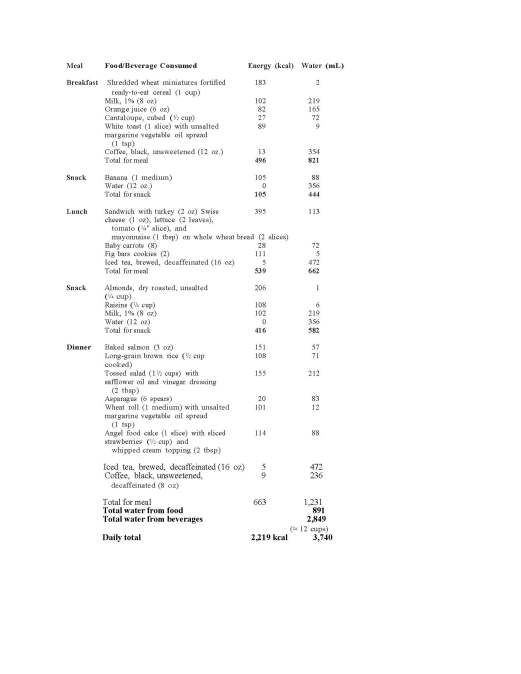
Table

NOTE: This diet meets the Adequate Intake or the Recommended Dietary Allowance for adult men and women for all nutrients for which one has been established (for fiber, it meets the ratio of 14 g/1,000 kcal) and provides energy nutrients within the acceptable macronutrient distribution ranges. Nutrient totals may not equal the sum of the parts, due to rounding. Vegetables prepared without salt.

Food composition data: U.S. Department of Agriculture, Agricultural Research Service, Nutrient Database for Standard Reference, Release 16.

DATA SOURCE: ENVIRON International

So, what is the optimal source of hydration?

When I came to the US, 37 years ago, I somehow created associations that beer is the only drink that really goes with pizza and at McDonald’s you always ate hamburger with French fries and Coke. I don’t know how those associations happened, since I did not eat pizzas or McDonald’s’ hamburgers before coming to the US. I guess it was from watching all those TV commercials or just mimicking what everyone else around me was doing.   In fact, it was four years later that watching a friend of mine, I learned that you could actually ask for water at McDonalds.

Fruits and vegetables are definitely good sources for water. Other than getting water from food, what about beverages? Are all beverages, coffees, tea, ice tea, milk, sodas, juices, beer, and wine as good a source of water?

Given the western culture, the answer could be quite confusing.

In research literature, there seems to be some controversy about whether coffee and alcohol are only transitional diuretics or permanent diuretics. Some say that caffeine and alcohol actually cause dehydration. Others disagree.

And, the citrus industry convinced us over two decades ago that “orange juice is not just for breakfast anymore”, so we should be  drinking that all day long.

Coke and Pepsi, of course, promise us sex and happiness.

“Got Milk” teaches us that all the hip people drink milk and it is a fun drink and of course, it is the only source of calcium out there.

Beer is the real beverage to quench thirst, besides it gets us sex and popularity.

Wine is definitely one for sophisticated people and of course makes us live longer.

All this just to get people to drink their stuff to get hydrated! So, what is one to do?

I tend to agree with Joe Dillon, who likes to say, “Just because it is wet, does not mean it will hydrate you.”

Bottom Line

My take on all this is to ask the basic question: when I drink a beverage for hydration, do I want the collateral stuff?

Whether it is caffeine, or alcohol, or sugars or artificial sweeteners, or artificial colors, or whatever else,  if I do want the collateral stuff, then the particular beverage at that moment is an acceptable, desirable or even a good source of hydration. If not, I rather just drink water.

And, in most of the situations, when I am looking to hydrate myself, I rather go directly to the source of hydration that my body is ultimately looking for, which, of course, is Water.

What do you think of this approach?

Do you feel that this simplifies the confusion about water and hydration?

Do you see a hole in this approach? What would you do differently?

Post #27 – Eating for Optimal Health Part VI – Incorporate sufficient protein in your diet

02 Sunday Nov 2014

Posted by purposelyliveto120 in Ideal Body Weight, Lean Mass, Living to 120, Nutrition, Optimal Health, Optimal Nutrition

≈ Leave a comment

Tags

Aging, Lifestyle

In blog post of 9/29/2014: So, what should you eat for optimal health?, I listed the seven basic principles I have extracted from the many diet books and resources I have studied. These principles are:

  1. What you eat, how much you eat and when you eat, all matter
  2. Eat clean
  3. Eat lots of vegetables and fruits
  4. Use only healthy fats and fat sources
  5. Incorporate sufficient proteins in your diet
  6. Best beverage to drink is pure water
  7. Add or subtract specific foods based on your personal needs

In the last posts, we discussed the first four of these principles. Today, let’s focus on the fifth principle: Incorporate sufficient protein in your diet. And, as usual without any fluff stuff, let’s get to it.

First, what are proteins and what is the big deal?

Proteins are the main building blocks of the body. They’re used to make muscles, tendons, organs and skin. Proteins are also used to make enzymes, hormones, neurotransmitters and various tiny molecules that serve important functions.

Without protein, life as we know it would not be possible.

Proteins are made out of smaller molecules called amino acids, which are linked together like beads on a string. The linked amino acids form long protein chains, which are then folded into complex shapes.

Some of these amino acids can be produced by the body, while we must get others from the diet. The ones we cannot produce and must get from our foods are called the “indispensable” (sometimes also called “essential”) amino acids.

Protein from animal sources such as meat, poultry, fish, eggs, milk, cheese, and yogurt provide all nine indispensable amino acids, and for this reason are referred to as “complete proteins.”

Proteins from plants, legumes, grains, nuts, seeds, and vegetables tend to be deficient in one or more of the indispensable amino acids and are called “incomplete proteins.”

So, how much protein do we need?

There are different opinions on how much protein we actually need.

Most official nutrition organizations recommend a fairly modest protein intake. Food and Nutrition Board of Institute of Medicine of the National Academies in their Dietary Reference Intakes (DRI) reference manual recommends 0.8 grams of protein per kilogram of body weight, or 0.36 grams per pound. This amounts to:

  • 56 grams per day for the average sedentary man.
  • 46 grams per day for the average sedentary woman.

These are clearly amounts below which nutritional deficiency will result. Interestingly, DRI reference manual does not specify any upper limit at which protein might be harmful, although there is quite a bit of discussion about adverse effects of taking too much of a specific amino acid.

Most experts agrees that protein needs depends upon a number of factors that include activity level, age, muscle (or lean) mass and current state of health. 

But still, how much?

The range seems to be from 0.5 gram to 1.0 grams per pound of body weight. In case one is overweight, it is recommended to use lean mass weight to calculate the protein need.

Most optimal health experts, such as Joe Dillon (The Joe Dillon Difference), Dr. Life (Life Plan), Bill Phillips (Body for Life) whose focus is on building optimal muscle mass, recommend amounts on the higher end of the range. That is, 1.0 or 1.2 grams per pound of body weight per day.

What are the best sources of protein?

The factors often discussed in terms of quality of protein are efficiency of absorption, and how “complete” the protein is, i.e., does it contain all indispensable  amino acids. Another important factor I believe is whether eating enough protein will bust your carbs, fats or calories budget.

Eating lots of breads may give you sufficient proteins but it will probably bust the carbs and calories budgets.  Also, eating lots of rich or fatty meats for sufficient protein will most likely bust your fats budget.

Joe Dillon offers the following hierarchy for selecting optimal sources of lean, quality protein (from highest to lowest):

  • 100% Whey protein isolate powder
  • Egg whites
  • Wild Game (venison, buffalo, elk, moose, etc.)
  • Salmon, Ahi Tuna
  • Turkey (white meat, dark meat, no skin)
  • Fish (all kinds)
  • Chicken (white meat only, no skin)
  • Shellfish (oysters, mussels, clams, lobster, shrimp, crab)
  • Nonfat Dairy (nonfat milk, nonfat cheese, nonfat cottage cheese, nonfat plain yogurt)

But how much of these foods should I eat?

Here is a quick guide:

  • 3 ounces of lean meat or poultry contain about 25 g of protein,
  • 3 ounces of fish contain about 20 g of protein
  • 1 cup of soybeans supplies about 20 g of protein.
  • 1 cup of yogurt is approximately 8 g,
  • 1 cup of milk is 8 g
  • 1 egg or 1 ounce of cheese contains about 6 g
  • One cup of legumes has approximately 15 g of protein
  • Cereals, grains, nuts, and vegetables contain about 2 g of protein per serving.

Bottom Line:

Still confused? May be this will help. Looking for optimal nutrition, this is what I am doing:

  1. Since I am interested in continuing to build my lean mass reserves, I decided to budget protein in the upper end of the range, about 1 gram per pound of my body weight. I weigh 161 plus minus 2 pounds these days, so 160 grams of protein per day is my target.
  2. I am a vegetarian, I assume I get about 10 to 20 grams from vegetables, legumes and eggs and egg whites.
  3. I supplement the remaining using shakes of whey isolates or whey concentrates and isolates mixed. That makes for shakes 4 to 5 times a day: breakfast, lunch, while going home from work, post-exercise and sometime before going to bed. If I ate meat, I will do just one or two shakes a day.

What do you think of this approach?

Do you feel that this simplifies the confusion about proteins?

Do you see a hole in this approach? What would you do differently?

Post #26 – Eating for Optimal Health Part V – Eat Only Healthy Fats and Fat Sources

27 Monday Oct 2014

Posted by purposelyliveto120 in Living to 120, Nutrition, Optimal Health, Optimal Nutrition, wellness

≈ 1 Comment

Tags

Cholesterol, Lifestyle

In blog post of 9/29/2014: So, what should you eat for optimal health?, I listed the seven basic principles I have extracted from the many diet books and resources I have studied. These principles are:

  1. What you eat, how much you eat and when you eat, all matter
  2. Eat clean
  3. Eat lots of vegetables and fruits
  4. Use only healthy fats and fat sources
  5. Incorporate sufficient proteins in your diet
  6. Best beverage to drink is pure water
  7. Add or subtract specific foods based on your personal needs

In the last two posts, we discussed the first three of these principles. Today, let’s focus on the fourth principle: Eat only healthy fats and fat sources. And, as usual without any fluff stuff, let’s get to it.

How much and what types of fats one should for optimal health is definitely a very controversial topic. Let’s see if I can put this controversy in proper perspective and reach some workable conclusions in this post.

To make sure that we can intelligently talk about this topics without having to get a graduate degree in biochemistry, first some basic terminology. Lipids, triglycerides, fatty acids, essential fatty acids, fats, saturated fats, monounsaturated fats and polyunsaturated fats, trans fats, and oils are some common terms we need to understand to really talk about fats. Here are a layman’s definitions of these terms.

Lipids are group of molecules that are used by the body for storing energy, signaling, and acting as structural components of cell membranes. Lipids include waxes, triglycerides, and fat-soluble vitamins.

Triglycerides are lipids derived from glycerol and three fatty acids.

Fatty acids are made up of long chain of carbon hydrogen atoms and are important source of fuel for the body when metabolized. Based on the bond structures, fatty acids can be Monounsaturated, Polyunsaturated, Trans or Saturated.

If Polyunsaturated, based on where the double bonds are located on the chain, fatty acids can be omega-3, omega-6, omega-7 or omenga-9.

Essential fatty acids are those fatty acids that body cannot make. These are of two types: alpha-linolenic acid (an Omega-3 fatty acid) and linoleic acid (an omega-6 fatty acid)

Fats are a wide group of compounds whose basis is a fatty acid. Fats are called Monounsaturated, Polyunsaturated, Trans fats, or Saturated fats based on the structure of their corresponding fatty acid.

Oils are fats that are liquids at normal room temperature.   As you can see below, most oils and fats contain all three types of fats: saturated, monounsaturated, and polyunsaturated.

Oils and fat content

What most researchers seem to agree on?

  1. Trans Fats are bad – So, Crisco (or Dalda in India) is out. It is definitely bad for your health. Most people have already learned that and taken it out of their kitchens. But it is still quite prevalent for frying at home, baking pies and cookies and in processed food. In the US, since FDA has taken Trans Fats off of the Generally Regarded As Safe (GRAS) list, it is starting to disappear from processed and restaurant foods.
  2. Adding Essential Fats to your diet is good: While most people get sufficient Omega-6 in their diets they do not get enough Omega-3. So, adding alpha-linolenic acid (ALA), eicosapentaenoic acid (EPA), and docosahexaenoic acid (DHA) is good. Good sources of Omega-3 are fish, flax seeds and oil, safflor oil and Hemp. USDA recommends that at least 10% of the fat budget be Omega-3 fats.
  3. Small amount of saturated fats in diet is good: Saturated fats are needed for cell walls, hormone balance, cellular signaling and increasing HDL (the so called good cholesterol).

What is controversial?

  1. What percent of calories should come from fats: There are researchers who have demonstrated that by reducing the fat intake to 10%, you can dramatically change the lipid profile in the body, cholesterol, triglycerides issues can be totally eliminated, while significantly improving the health of cardio-vascular system (For example, see Prevent and Reverse Heart Disease by Caldewell Esselystyn, Jr. MD., The Perfect 10 diet by Michael Aziz, MD). However, to get to these levels for fat intakes, it means adopting vegan or almost-vegan lifestyle and that of course leads to the controversy.
  2. Whether to totally eliminate saturated fats from the diet: It is well-known that too much saturated fat leads to poor cardio-vascular health. However, very small amount of saturated fats are needed and found beneficial for cellular health, hormone balance and cellular signaling and increasing HDL. Controversy therefore comes when people arguing all or nothing approach to saturated fats.
  3. Fats vs. Carbs: When government and media started touting benefits of low fat diets starting in 1960’s and 70’s, people in the US started to replace their high (saturated) fat diets with low-fat high-sugar diet. If you look at any package in the grocery store, if it says, low fat, it usually means high carbs or sugars, or vice versa. This led to obesity and other issues. So, all this means sugars are bad, which means fats must be good, right?
  4. Trans Fats vs. saturated fats: Unfortunately, this controversy was created on purpose. Proctor and Gamble deployed a sales strategy to displace lards as saturated fats by Crisco vegetable shortening. This plot thickens, since P&G was the original funding source for American Heart Association. With 100 years of marketing behind it, there is got to be sufficient confusion prevalent.

Bottom line: So, what is one to do? Here is what I have decided to do, in pursuit of optimal health, based on the best current information I have:

  1. Keep fat intake to less than 15% of daily calories. So, for a 2000 calorie diet, 300 calories or 33 grams from fat in a day.
  2. Take four grams of fish oil and 2 grams of flax seed oil every day. One capsule with each meal or snack.
  3. Limit saturated fats to under  5% of daily calories. Most sources of fats, as we saw in the table above contain some saturate fats, so I don’t really need to add saturated fats, even if we do all the cooking with olive oil. Occasional egg yoke or dab of butter is okay. Since I am a vegetarian,  limiting saturated fats to under 5%is not a big issue. But if I were eating meat, I will have to eat very lean cuts of meat to be able to stay within this constraint.
  4. No Trans Fats.
  5. Manage all macronutrients, fats, carbs and proteins to make sure they all are in the optimal range.

What do you think of this approach?

Do you feel that this simplifies the confusion about fats and good/bad fats?

Do you see a hole in this approach? What would you do differently?

Post #25 – Eating for Optimal Health Part IV – Eat Lots of Fruits and Vegetables

20 Monday Oct 2014

Posted by purposelyliveto120 in Aging, Nutrition, Optimal Health, Optimal Nutrition

≈ Leave a comment

Tags

Optimal Nutrition

In blog post of 9/29/2014: So, what should you eat for optimal health?, I listed the seven basic principles I have extracted from the many diet books and resources I have studied. These principles are:

  1. What you eat, how much you eat and when you eat, all matter
  2. Eat clean
  3. Eat lots of vegetables and fruits
  4. Use only healthy fats and fat sources
  5. Incorporate sufficient proteins in your diet
  6. Best beverage to drink is pure water
  7. Add or subtract specific foods based on your personal needs

In the last two posts, we discussed the first two of these principles, what you eat, how much you eat, and when you eat, all matter and eating clean. Today, let’s focus on the third principle: Eat lots of fruits and vegetables. And, as usual without any fluff stuff, let’s get to it.

First, why eat fruits and vegetables? Why does everyone, moms, USDA, doctors, most diet books, even the first lady Michelle Obama, all harp on eating lots of fruits and vegetables?

In the first post of this series, we talked about what makes up everything that body needs:

  • Oxygen
  • Water
  • Macro nutrients: carbs, proteins and fats
  • Micro nutrients: vitamins and minerals
  • Enzymes
  • Bacteria
  • Certain molecules

Turns out that fruits and vegetables can deliver everything on this list other than oxygen.

Number one content of most fruits and vegetables is water. Here is how.

Carbs, protein and fats are all available in fruits and vegetables. Most people have no problem imagining how fruits and vegetables are rich source of carbs. And, may be the same is true for fats too. After all olive oil must come from olives, vegetable oil must come from vegetables, and corn oil must come from corn etc.

It is the protein that most people have hard time imagining in fruits and vegetables. While most vegetables and fruits contain some protein, as the following list shows, it is the nuts, seeds, lentils, beans and grains that contain the most. I extracted this list from the USDA Nutrients Database. Weight, protein, carbs and fats are in grams.

Description Weight Measure Protein Carbs Fats
Soybeans, green, raw 256 1.0 cup        33.15          28.29        17.41
Soybeans, green, cooked, boiled, drained, without salt 180 1.0 cup        22.23          19.89        11.52
Cowpeas (blackeyes), immature seeds, frozen, cooked, boiled, drained, without salt 170 1.0 cup        14.43          40.39          1.12
Lima beans, immature seeds, frozen, baby, unprepared 164 1.0 cup        12.45          41.23          0.72
Edamame, frozen, unprepared 118 1.0 cup        12.10          10.12          5.58
Lima beans, immature seeds, frozen, baby, cooked, boiled, drained, without salt 180 1.0 cup        11.97          35.01          0.54
Lima beans, immature seeds, cooked, boiled, drained, without salt 170 1.0 cup        11.58          40.19          0.54
Peas, mature seeds, sprouted, raw 120 1.0 cup        10.56          32.53          0.82
Lima beans, immature seeds, frozen, fordhook, unprepared 160 1.0 cup        10.24          31.73          0.56
Beans, pinto, immature seeds, frozen, unprepared 94 10 oz          9.21          30.55          0.47
Garlic, raw 136 1.0 cup          8.65          44.96          0.68
Peas and carrots, frozen, cooked, boiled, drained, without salt 278 10 oz          8.59          28.13          1.17
Soybeans, mature seeds, sprouted, cooked, steamed 94 1.0 cup          7.96            6.14          4.18
Potatoes, Russet, flesh and skin, baked 299 1.0 large          7.86          64.11          0.39
Peas, green, raw 145 1.0 cup          7.86          20.95          0.58
Beans, kidney, mature seeds, sprouted, raw 184 1.0 cup          7.73            7.54          0.92
Potatoes, scalloped, home-prepared with butter 245 1.0 cup          7.03          26.41          9.02
Broccoli, frozen, chopped, cooked, boiled, drained, without salt 184 1.0 cup          5.70            9.84          0.22
Taro, tahitian, cooked, without salt 137 1.0 cup          5.70            9.38          0.93
Turnip greens, frozen, cooked, boiled, drained, without salt 164 1.0 cup          5.49            8.17          0.69
Asparagus, frozen, cooked, boiled, drained, without salt 180 1.0 cup          5.31            3.46          0.76
Cowpeas (blackeyes), immature seeds, cooked, boiled, drained, without salt 165 1.0 cup          5.23          33.53          0.63
Asparagus, canned, drained solids 242 1.0 cup          5.18            5.95          1.57
Squash, winter, hubbard, baked, with salt 205 1.0 cup          5.08          22.16          1.27
Corn, sweet, yellow, canned, vacuum pack, regular pack 210 1.0 cup          5.06          40.82          1.05
Potatoes, mashed, dehydrated, flakes without milk, dry form 60 1.0 cup          5.00          48.70          0.25
Corn, sweet, yellow, canned, brine pack, regular pack, solids and liquids 256 1.0 cup          4.99          35.48          1.97
Spinach, canned, regular pack, solids and liquids 234 1.0 cup          4.94            6.83          0.87
Turnip greens and turnips, frozen, cooked, boiled, drained, with salt 163 1.0 cup          4.87            7.73          0.62
Potatoes, mashed, dehydrated, prepared from granules with milk, water and margarine added 210 1.0 cup          4.47          33.87        10.08
Broccoli, frozen, chopped, unprepared 156 1.0 cup          4.38            7.46          0.45
Potatoes, mashed, dehydrated, prepared from granules without milk, whole milk and butter added 210 1.0 cup          4.30          30.16        10.42
Cowpeas (blackeyes), immature seeds, raw 145 1.0 cup          4.28          27.30          0.51
Corn, sweet, yellow, frozen, kernels cut off cob, boiled, drained, without salt 165 1.0 cup          4.21          31.84          1.11
Tomato products, canned, puree, without salt added 250 1.0 cup          4.12          22.45          0.52
Corn, sweet, yellow, frozen, kernels cut off cob, unprepared 136 1.0 cup          4.11          28.17          1.06
Peas, edible-podded, frozen, unprepared 144 1.0 cup          4.03          10.37          0.43
Mushrooms, portabella, grilled 121 1.0 cup          3.97            5.37          0.70

In addition to the macro nutrients, i.e., carbs, proteins and fats, fruits and vegetables also contain lots and lots of micro nutrients, i.e., vitamins, mineral, enzymes, good bacteria and trace elements of other molecules, some of which are known to be beneficial to health and others that are still being discovered. For example, just click on the corresponding words to see how many different micronutrients are contained in broccoli and apple.

Finally, fruits and vegetables also provide both soluble and non-soluble fiber, which are important for digestive and elimination systems. Fiber in diet helps slow the digestive process and is great for sugar management. On the other hand, it also means that not 100% macro nutrients are extracted and absorbed by the body. So, if you want to, say get 80 grams of proteins from fruits and vegetables, you may need to ingest enough fruits and vegetables to provide 100 grams of protein.

The second part of this principle is to eat a “lots” of fruits and vegetables. This implies both quantity and variety.

These days, USDA recommends that you should fill half your plate with fruits and vegetables at every meal. USDA’s earlier standard used by 6 to 8 serving of fruits and vegetables each day. Check out fruitsandvegetablesmorematters.org.

So, basically “lots” really means that if you were getting all your protein requirements met by eating fruits and vegetables, you have to make sure you are eating enough of the right kinds of fruits and vegetables so your protein intake requirement is met without busting your fat or carbs intake.

Bottom line: Still sounds confusing as to how to live with this principle? Here is what I have figured out for myself:

  1. Eat a wide variety of fruits and vegetables to your fill at meals and for snacks.

For example, in a typical week, I might eat apples, oranges, strawberries, blueberries, black berries, bananas, grapes, watermelon, cantaloupe, two three variety of beans/lentils, rice, couscous, spinach, lettuce, baby bokchoi, other spring greens, green beans, carrots, broccoli, cauliflower, potatoes, peas, cucumber, radishes, almonds, cashews. If I don’t eat sugar or sugar added products, fruits and vegetables taste absolutely delicious.

  1. Stay away from (or eat sparingly or with great portion control) breads, tortilla, pastas.

It is pretty easy to stay within my budgets for carbs, and fats without much effort, while having my fill with fruits and vegetables, cooked and/or raw. If I was to have my fill with breads, tortillas, pasta, or rice I would not be able to eat the quantity and variety of fruits and vegetables without busting my carbs and/or fats budget.

  1. Use quality protein sources (meats or protein shakes) to meet the minimum protein requirements.

While I may be getting a lot of protein from beans, lentils, nuts and vegetables, I still rely on whey protein to get my minimum required protein intake, especially, for muscle building.

What do you think of this approach?

Do you feel that this simplifies the confusing statement “eat lots of fruits and vegetables”?

Do you see a hole in this approach? What would you do differently?

Post #24 – Eating for Optimal Health Part III – Eat Clean

12 Sunday Oct 2014

Posted by purposelyliveto120 in Nutrition, Optimal Health, wellness

≈ Leave a comment

Tags

Allergies

In blog post of 9/29/2014: So, what should you eat for optimal health?, I listed the seven basic principles I have extracted from the many diet books and resources I have studied. These principles are:

  1. What you eat, how much you eat and when you eat, all matter
  2. Eat clean
  3. Eat lots of vegetables and fruits
  4. Use only healthy fats and fat sources
  5. Incorporate sufficient proteins in your diet
  6. Best beverage to drink is pure water
  7. Add or subtract specific foods based on your personal needs

Last week we discussed the first of these principles, what you eat, how much you eat, and when you eat, all matter. Today, let’s focus on the second principle: Eat Clean. And, as usual without any fluff stuff, let’s get to it.

Dr. Mark Hyman likes to say, “If you eat crap, you feel like crap”. You may have heard a variation of this same theme.

Here is how to recognize foods to which the term “crap” may apply:

  • Junk foods – Foods that have excessive and/or unhealthy fats and/or excessive sugars/salt
  • Foods with empty calories: – that do not contain any nutrients other than sugar for calories. For example sodas and candy.
  • Comfort Foods: Foods with high sugar, salt and/or fat content
  • Processed Foods: Foods made in a plant (or factory)
  • Food with questionable additives – Ingredients whose names you have difficulty pronouncing
  • Foods with artificial flavorings
  • Foods with “non-sugars” – that use artificial sweeteners such as saccharin or aspartame
  • Foods that use High Fructose Corn Syrup as sweetener
  • Foods that use partially hydrogenated oils
  • Meat or Poultry grown with hormones and antibiotics and/or in unhealthy conditions
  • Tainted Sea Food – with heavy metals such as mercury or other impurities
  • Fruits and Vegetables laced with pesticides
  • Unclean water or foods prepared with unclean water

That’s pretty much it. So, if you eliminate these types of foods from your diet, you are eating clean.

There are a lot of research papers, books and literature on why eating such foods is unhealthy or not optimal for your health. Some of the reasons are quite nuanced, but a lot of the reasons are quite stark and plain:

  • In addition to being unhealthy, foods with excess sugars, salts and fats tend to be addicting.
  • We all know by now how hydrogenated oils lead to issues with coronary health.
  • You don’t have to go to medical school to figure out why foods with foreign hormones, chemicals, pesticides, or heavy metals are bad for our health.
  • Ingesting high fructose corn syrup can damage the liver and can create issues such as allergies.
  • Artificial sweeteners are known to interfere with expression of genes.

Two areas, related to this topic of eating clean, seem to generate a lot of conversation: GMO vs. No-GMO and Organic vs. Non-organic.

Some people won’t go near GMO or genetically modified foods, but others don’t mind. Same debate goes on between organic and non-organic. Safer option to me seems to be eat organic and non-GMO, whenever possible. Although, organic is really not required for the foods that are grown with minimal or no-pesticides, have thick peels or you peel them before eating.

There are plenty of lists of foods on the internet for which eating organics reduce pesticides significantly. For example, this Dirty Dozen List recommends, you buy the following foods organically grown because of high pesticide contents and because they either have very thin skis or are often eaten without peeling:

  • Apples
  • Celery
  • Cherry Tomatoes
  • Cucumbers
  • Grapes
  • Hot Peppers
  • Nectarines
  • Peaches
  • Potatoes
  • Strawberries
  • Spinach
  • Sweet Bell Peppers
  • Kale
  • Collard Greens
  • Zucchini
  • Lettuce
  • Blueberries
  • Fatty Meats
  • Milk
  • Coffee
  • Wine
  • Chocolate

On the other hand, the following are quite clean and are not necessary to buy organic:

  • Onions
  • Sweet Corn
  • Pineapple
  • Avocado
  • Asparagus
  • Frozen Sweet peas
  • Mango
  • Papayas
  • Eggplant
  • Cantaloupe (domestic)
  • Kiwi
  • Cabbage
  • Watermelon
  • Sweet Potatoes
  • Grapefruit
  • Mushrooms

What do you think -does this make sense?

Do you feel there are other ways to detect clean vs. “crap”?

Are there other types of foods that you will put in organic vs. non-organic categories?

Post #23 – Eating for Optimal Health Part II – What you eat, how much you eat and when you eat, all matter.

06 Monday Oct 2014

Posted by purposelyliveto120 in Ideal Body Weight, Lean Mass, Living to 120, Nutrition, Optimal Health, Percent Body Fat, wellness

≈ Leave a comment

Tags

Aging, Lifestyle

Eating for Optimal Health Part II – What you eat, how much you eat and when you eat, all matter.

In last week’s blog post: So, what should you eat for optimal health? – Part I, I listed the seven basic principles I have extracted from the many diet books and resources I have studied. These principles are:

  1. What you eat, how much you eat and when you eat, all matter
  2. Eat clean
  3. Eat lots of vegetables and fruits
  4. Use only healthy fats and fat sources
  5. Incorporate sufficient proteins in your diet
  6. Best beverage to drink is pure water
  7. Add or subtract specific foods based on your personal needs

Today, let’s focus on the very first principle: What you eat, how much you eat and when you eat, all matter. And, without any fluff, let’s get to it.

What you eat: Our physical bodies need:

  • Oxygen
  • Water
  • Macro nutrients: carbs, proteins and fats
  • Micro nutrients: vitamins and minerals
  • Enzymes
  • Bacteria
  • Certain molecules

For optimal health, what we eat needs to provide all these items in optimal quantities. If any of these are taken in insufficient quantities, suboptimal health will result.

How much you eat: One aspect of how much to eat is based on how much energy we need every day. The other aspect is to eat so as to receive optimal quantities for our bodies’ needs a) through g) above.

The first aspect about energy, in-turn depends upon two factors. How many Kcals (or Calories) do we need for the basic metabolic activities (beating heart, circulation of blood, breathing, maintaining body temperature etc.). And, for other physical activities which can depend upon our lifestyle, taking elevators vs. taking stairs, number of steps walked in a day, exercise or no exercise, driving to work or biking to work, doing the work manually or letting machines do the work, etc.

And, there is yet another factor that dictates how much to eat question, i.e., how efficiently is your body able to convert food to energy. Basic metabolic cycle, called Krebs Cycle or the Citric Acid Cycle involves myriads of elements to convert carbs, protein and water into energy.

When to eat: While there are many theories as to when to eat, there is one major principle that is well understood and is critical to optimal health: Sugar Management. Body converts carbohydrates into glucose (sugars) before they can be converted to energy using the Krebs cycle. Rate at which carbs convert to sugars depends on the glycemic index of the specific food. And, how much sugar is generated, also called glycemic load, in this process is based on glycemic index and the quantity of food.

Body either uses up all the glucose it generates or it stores away what it cannot use in the form of body fat. For optimal health, one must eat just enough, so that all of it can be converted into stored energy rather than stored fat. This means eating meals more often, if necessary, to not generate excess that will have to be stored away as fat.

Bottom line and My Personal Plan: Given all these factors, you can easily imagine why there is much room for controversy about what to eat, how much to eat and when to eat.

When one expert says, “Just figure out  how many calories you need and then simply eat that many calories.”

Next expert might say, “Not true, because you still need all of the elements 1 through 7 that body needs. That is why, 2500 calories from sodas is not the same as 2500 calories from fruits and vegetables.”

Yet, third expert may argue that if you are missing just a few key ingredients, your energy cycle may be all messed up and nothing else will matter.

So, what is one to do? The best answer, I have synthesized from all those book and resources I mentioned in part I, is as follows. I am here using my personal example to illustrate. These days, my weight is 161 (plus minus 2 lbs.)

  1. Decide how many calories you need to consume in a day, based on your build and life style (usually 2300 calories to 2800 calories):

In my case, I decided about 2500 calories meet my daily need.

  1. If you are not at optimal percent body fat, reduce the calorie in-take by 20%

So in my case, since I am still working on losing body fat, I budgeted 2500 x 80% = 2000 calories

  1. 15% should come from fat

For me, 2000 x 15% = 300 calories. 300/9 = 33 grams of fat

  1. Budget 1 gram per pound of body weight for protein.

For me: 160 grams of proteins. 160gms x 4 cals/ gm = 640 calories

  1. What remains is budget for carbs. Thus, Calories from carbs = Total Calorie budget – fat cals – protein calories. Divide by 4 for number of grams of carbs.

So my daily intake budgets are:

  • Total 2000 calories
  • 300 cals from fat, i.e., 33 gms
  • 640 cals from protein, i.e., 160 gms
  • 1060 cals from carbs, i.e., 265 gms.
  1. Use fruits and vegetables as the basis for carbs that will not only meet carb requirements but also most of the micro nutrients. It is really easy to blow carbs budget with breads and pasta, and most of those also have very high glycemic load.
  2. Use your choice of protein sources for the budgeted amount of protein requirement. Again, be careful in selecting protein sources, since it is very easy to blow the fat budget with poor choice of protein sources.
  3. Break up intake into at least six meals and mix proteins with carbs for each meal to keep sugar level throughout out the day and also prevent spikes after each meal.

For one day, I did a complete journal of what I ate and also using resources on the Internet figured calories for carbs, proteins and fats. This was a particular intense day during my 21-day Muscle Mania challenge. I don’t always do strength training workout with my trainer and Bikram yoga the same day.

Below here is the result. Remember, I am a vegetarian and I have been using Whey Protein as my major source of protein.

You can Click on the picture to enlarge it, if it is not readable.

Meal Planner and Journal for Ashok

What do you think of this approach?

Do you feel that this simplifies the mumbo jumbo of what to eat, how much to eat and when to eat for optimal health?

Do you see a hole in this approach? What would you do differently?

← Older posts
Newer posts →

Recent Posts

  • Post #69 – Resources I used to rehabilitate my knee: Part II – Knee Misalignment Issue
  • Post #68 – Resources I used to rehabilitate my knee: Part I – Diagnose and Fix Structural Issue
  • Post #67 – What is the Minimum Stack of Supplements to Take?
  • Post #66 – Optimal Health through Optimal Breathing
  • Post #65 – Fasting, the old new technology and panacea for Optimal Health – Part III

Recent Comments

purposelyliveto120's avatarpurposelyliveto120 on Post #66 – Optimal Health thro…
Michael Jansen Jr.'s avatarMichael Jansen Jr. on Post #66 – Optimal Health thro…
Michael Jansen Jr.'s avatarMichael Jansen Jr. on Post #65 – Fasting, the…
Sherri Boczar's avatarSherri Boczar on Post #64 – Fasting, the…
Sherri Boczar's avatarSherri Boczar on Post #63 – Fasting, the…

Archives

  • July 2024
  • June 2024
  • June 2022
  • January 2021
  • September 2019
  • August 2019
  • July 2019
  • September 2018
  • May 2018
  • February 2018
  • July 2017
  • September 2016
  • August 2016
  • July 2016
  • June 2016
  • May 2016
  • April 2016
  • March 2016
  • February 2016
  • January 2016
  • December 2015
  • November 2015
  • October 2015
  • September 2015
  • August 2015
  • July 2015
  • June 2015
  • May 2015
  • April 2015
  • March 2015
  • February 2015
  • January 2015
  • December 2014
  • November 2014
  • October 2014
  • September 2014
  • August 2014
  • July 2014
  • June 2014
  • May 2014
  • April 2014
  • March 2014

Categories

  • Aging
  • Autophagy
  • Bikram Yoga
  • Biomarkers for Stress
  • Breathing
  • Causes of Death
  • Causes of Death
  • Dying
  • Fasting
  • Functional Medicine
  • Ideal Body Weight
  • knee-pain
  • Lean Mass
  • Life-Span
  • Living to 120
  • meditation
  • Mental Health
  • Muscoskeletal alignment
  • Nutrition
  • Optimal Exercise
  • Optimal Health
  • Optimal Nutrition
  • Optimal Sleep
  • Percent Body Fat
  • Puposely Living
  • Quality of Life
  • Reversing Chronic Diseases
  • Stress
  • Supplements
  • TM
  • Uncategorized
  • Vigor
  • Vitality
  • wellness
  • Yoga

Meta

  • Create account
  • Log in
  • Entries feed
  • Comments feed
  • WordPress.com

Recent Posts

  • Post #69 – Resources I used to rehabilitate my knee: Part II – Knee Misalignment Issue
  • Post #68 – Resources I used to rehabilitate my knee: Part I – Diagnose and Fix Structural Issue
  • Post #67 – What is the Minimum Stack of Supplements to Take?
  • Post #66 – Optimal Health through Optimal Breathing
  • Post #65 – Fasting, the old new technology and panacea for Optimal Health – Part III

Recent Comments

purposelyliveto120's avatarpurposelyliveto120 on Post #66 – Optimal Health thro…
Michael Jansen Jr.'s avatarMichael Jansen Jr. on Post #66 – Optimal Health thro…
Michael Jansen Jr.'s avatarMichael Jansen Jr. on Post #65 – Fasting, the…
Sherri Boczar's avatarSherri Boczar on Post #64 – Fasting, the…
Sherri Boczar's avatarSherri Boczar on Post #63 – Fasting, the…

Archives

  • July 2024
  • June 2024
  • June 2022
  • January 2021
  • September 2019
  • August 2019
  • July 2019
  • September 2018
  • May 2018
  • February 2018
  • July 2017
  • September 2016
  • August 2016
  • July 2016
  • June 2016
  • May 2016
  • April 2016
  • March 2016
  • February 2016
  • January 2016
  • December 2015
  • November 2015
  • October 2015
  • September 2015
  • August 2015
  • July 2015
  • June 2015
  • May 2015
  • April 2015
  • March 2015
  • February 2015
  • January 2015
  • December 2014
  • November 2014
  • October 2014
  • September 2014
  • August 2014
  • July 2014
  • June 2014
  • May 2014
  • April 2014
  • March 2014

Categories

  • Aging
  • Autophagy
  • Bikram Yoga
  • Biomarkers for Stress
  • Breathing
  • Causes of Death
  • Causes of Death
  • Dying
  • Fasting
  • Functional Medicine
  • Ideal Body Weight
  • knee-pain
  • Lean Mass
  • Life-Span
  • Living to 120
  • meditation
  • Mental Health
  • Muscoskeletal alignment
  • Nutrition
  • Optimal Exercise
  • Optimal Health
  • Optimal Nutrition
  • Optimal Sleep
  • Percent Body Fat
  • Puposely Living
  • Quality of Life
  • Reversing Chronic Diseases
  • Stress
  • Supplements
  • TM
  • Uncategorized
  • Vigor
  • Vitality
  • wellness
  • Yoga

Meta

  • Create account
  • Log in
  • Entries feed
  • Comments feed
  • WordPress.com

Blog at WordPress.com.

  • Subscribe Subscribed
    • Purposely Live to120
    • Join 68 other subscribers
    • Already have a WordPress.com account? Log in now.
    • Purposely Live to120
    • Subscribe Subscribed
    • Sign up
    • Log in
    • Report this content
    • View site in Reader
    • Manage subscriptions
    • Collapse this bar
 

Loading Comments...