Post #8 – So, did I tell you the story about my allergies?

Tags

, , , ,

Or, my first lesson that chronic “diseases” can be reversed.

One day in the fall of 1985, at the University of Maryland, I was walking around my office rubbing my itchy eyes to get some relief. My secretary Janice said that my eyes looked bloodshot and suggested that I should go get them checked out with my doctor. When I told her that I did not have a doctor, she promptly made an appointment with her own doctor.

The doctor took a quick look at my eyes and told me that it was “just seasonal allergies.” I had arrived from India eight year earlier and can honestly say that I had never heard of the word “allergies” before coming to the US. So naturally, I asked the doc what seasonal allergies were. He said not to worry too much about it. It is probably Ragweed that I was allergic to. I should just go buy a bottle of non-prescription one milligram Chlorpheniramine, a generic anti-histamine, to take it for a few weeks until the season passed. When I asked him how I would know when to stop taking it, he said to take it for just a few weeks, I would know when season changes and not to worry too much about it since it was not a big deal.

Well, the following year, my allergies were a little worse. I started sniffling in addition to having itchy eyes. So, I started taking 2 milligrams. Even bigger dose the next year and so on. A few years later, my allergies would now kick-in even in spring season with pollen from blooming trees. In DC area, we have a lot of those. By 1995, I was suffering from allergies for about six months in a year, two months of spring season and four months of the fall season. Allergies had gotten so bad that I would feel like a zombie for half of the year, sneezing, sniffling with fever-like symptoms.

In 1993, I started learning how to fly. I could not afford to take drowsy antihistamine while flying. So, the doctor started to give me cocktails – non-drowsy stuff during the day and drowsy meds for the evenings. I was taking equivalent of 12mg antihistamine during the day and another 12 mg at night. Some of these meds had side-effects, like increased heart palpitations. So, I needed to go the doctor regularly to get checked out. My immune system was getting worse. I would get viral infection two three times a year, each episode started to last longer and longer

During all this time I would ask my physician about what was going on with my body and he would say, “Well, it’s the immune system. We don’t know much about the immune system.”

While this was going on, I had also gotten my cholesterol checked. My first blood test, in July 1990, showed my total cholesterol as 275, LDL of 205, HDL 39 and Triglycerides 155. Doctor gave me some pamphlets about lowering cholesterol through change in diet. Following that diet guidance, my cholesterol came down by as much as 52 points; this was still much higher than the then standard of 180 for the total cholesterol and 130 for LDL. My doc told me that I probably had genetic issues and had to get on some cholesterol lowering drug. A couple I tried had serious side effects like itchy skin and rash, so I discontinued those.

In September of 1995, I attended a 10 day program, Life Mastery, my first of Tony Robbins’s three Mastery University programs. At that program, on the first day, as part of creating our health baseline, we got our blood work done. My total cholesterol that day was 265. Seven days into the program, everybody who had excessive cholesterol got tested again. This time my total cholesterol was 183, an 82 points drop in 7 days! I was pleasantly shocked. That is big a change in one week. I had never been able to achieve such results, nor had my doctor ever shared even a possibility that such a change was possible with any change in lifestyle.

Armed with that experience and more knowledge about some methods for cleansing, when I returned I started to aggressively explore the possibility of curing my allergies. In my search, I ran into an organization called Washington University of Integrative Medicine. Starting October 1996, I worked with them to undertake a number of different lifestyle changes and therapies. I changed my eating habits. I quit dairy, meat, alcohol, coffee, and chocolate. They did colonics for me every other week to cleanse my colon, coffee colonics to stimulate my liver, and I would take various supplements to support my liver and immune system.

When the spring of 1997 rolled around, results became very clear. I suffered allergies only for just a few days at the beginning of that spring season and on a few very bad pollen days. In the fall of 1997 also, my experience was similar. Every season that followed, my allergies got better as opposed to getting worse as I had been experiencing since 1985.

A couple of years after my experiment with the alternative methods of curing my allergies, I went back to my physician. I needed to have him sign some papers so that I could use my health savings funds for alternative therapies. I told him my story of how I had cured my allergies. He thumped the table and got visibly angry and yelled, “These things don’t work!” I had always known him as a very mild mannered gentleman. Then I told him the other reason I had pursued this therapy was to manage my cholesterol. Regaining his composure, he said that cholesterol he could measure objectively. He challenged me to get blood work done and then return to see him.

Well, in March 1998, I got the blood work done. Total cholesterol came out to be 192 with LDL at 131. See the chart below of my cholesterol history for the last 25 years. Back paddling a little, he said, “The reason we don’t push lifestyle changes is because 95% people cannot make those changes. Whatever you are doing you should keep doing since it is working for you.” As for the allergies he wrote on my chart, SPONTANEOUS REMISSION. I left doctor’s office shaking my head in disbelief and decided to change doctor.
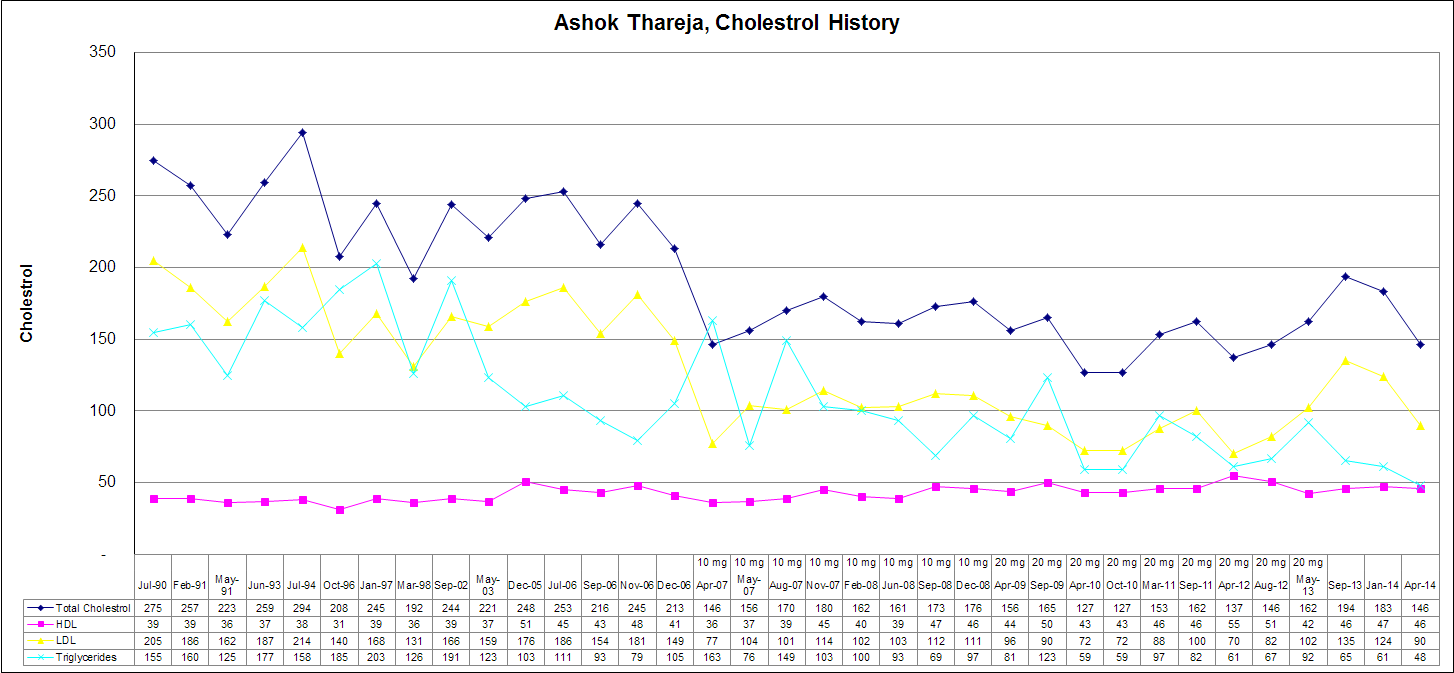
Cholestrol History

Nineteen years later now, I am totally free of allergies and my immune is system is strong enough that I don’t much get sick from common colds and flus. If I do catch a cold I bounce back in a day or two. Cholesterol is a whole another story. Few years later, the new standard for cholesterol became 150 for total and less than 100 for LDL. In 2007, I finally gave in and started taking Lipitor to bring my cholesterol within that range.

More recently, I have learned some more about impact of nutrition and lifestyle on coronary diseases and as a result made further changes. About a year ago, I discontinued Lipitor and have done three blood works since then, each a little bit better than the one before. The most recent blood work shows total cholesterol of 146 and LDL of 90. Moreover, my HDL is a fairly healthy 46, while triglycerides at 48, the lowest ever in 25 years!

So, that is my story about curing my allergies and managing cholesterol through nutrition. Motivated by this experience, I have accumulated a few other personal stories about preventing or curing certain other issues and have also collected further knowledge that many of the “chronic conditions” I discussed in earlier posts measured through vitality biomarkers are preventable and curable.

And that’s where I get this passion for collecting and disseminating evidence and research based information about preventing and curing chronic conditions through lifestyle changes.

Do you have a similar story?

Have you been able to reverse certain chronic conditions through lifestyle changes?

I would love to hear of such stories, both as a means for gathering inspiration and for collecting accurate experiential knowledge that we can pass along to others.
Post #7 – Can biomarkers help in the quest for vitality and longevity?

Tags

, , , , , , , ,

How do we die and how do we lose vitality questions so far have focused my attention on the hurdles to overcome. Some of these have to do with challenges that shorten or bring end to our lifespan. Other items are “diseases” that can decrease our vitality and vigor.

All of these items are, of course, important. For the moment, however, let me step away from these hurdles and reframe the questions.

Let us say, I don’t really have any disease, but I want to live a lifestyle to achieve the optimal health and lifespan. How can I objectively assess where I am presently and then either maintain or improve from here? In other words, how to pursue living an optimal health and vitality, not merely trying to be disease free?

Study of Biomarkers has been an area of aggressive research and pursuit in vitality and aging since the 1980’s.

Biomarkers (short for biological markers) are biological measures of a biological state. By definition, a biomarker is a characteristic that is objectively measured and evaluated as an indicator of normal biological processes, pathogenic processes or pharmacological responses to a therapeutic intervention.

In the context of aging, an important focus for biomarkers has been on finding “the clock” that potentially ticks away our lifespan. Discovery of telomere as a potentially genetic clock is one example of a biomarker that won Elizabeth Blackburn of the University of California San Francisco a Nobel Prize. More recently, Steve Horvath of UCLA has introduced another important biomarker to measure human aging through epigenetic signatures.

Both of these works have sparked fascinating research into areas of aging and extending lifespans. I would like to explore these topics in future blog posts.

On the other hand, for vitality, William Evans, PhD, and Irwin H. Rosenberg, MD, professors of nutrition and medicine, respectively, at Tufts University introduced a concept of biomarkers back in 1991 through their book Biomarkers (Simon and Schuster, 1991), updated in their book, BIOMARKERS: The 10 Keys to Prolonged Vitality (Simon and Schuster, 1992) and more recently updated in the Tufts University Health and Nutrition Letter.

In these publications, Evans and Rosenberg isolated the following signposts of vitality that can be altered for the better by changes in lifestyle:

  1. Muscle Mass
  2. Strength
  3. Basal Metabolic Rate
  4. Body Fat Percentage
  5. Aerobic Capacity
  6. Blood-sugar Tolerance
  7. Cholesterol/HDL Ratio
  8. Blood Pressure
  9. Bone density
  10. Ability to regulate Internal Temperature

These same 10 biomarkers keep showing up everywhere in preventative care, in strength training, in other training programs, in nutrition/diet plans and so on.

Additionally, other important biomarkers I have seen show up in various medical and scientific literature and studies on health, vitality and longevity are:

  1. Stress
  2. Inflammation
  3. Sleep
  4. Body’s pH
  5. Flexibility
  6. Balance
  7. Musculoskeletal alignment
  8. Physical and mental reaction time

So, the way I see it is this: the goal of achieving optimal health and lifespan should focus on developing lifestyle that optimizes these objectively measureable / observable biomarkers.

Any exercise plan, nutrition plan, lifestyle adaptations, and any medical program for achieving optimal vitality and lifespan thus must be measured against these criteria.

What do you think?

Do you know of other biomarkers that we can impact that are important for attaining optimal vitality and lifespan?

Post #6 – How do we lose vitality?

Tags

, , , , , ,

So, just to be sure, my goal (and hopefully your goal) is to purposely live to 120 (or the maximum possible lifespan) with the highest attainable vitality. To achieve that, I feel, I must understand about anything that might get in the way.

In the posts so far, I have been talking about achieving the lifespan of 120 and thereby about a subject that might have sounded morbid to some of you. That is about death and dying.

Let us change our focus to the second part of the goal: Maintaining Vitality. More specifically understanding the potential hurdles to  maintaining vitality, i.e., answering the question: how do we lose vitality?

A good definition of vitality I have seen is in the Free Dictionary, as “the capacity to live, grow or develop.” A good synonym of vitality for our purpose here is vigor, including physical, mental, intellectual vigor.

You have seen it. A fried or a family member is full of vitality and then you notice that he/she starts “going downhill”. The person used to be out and about all the time, went running, then started merely walking, then walking but not as often, and then stared to just hang around the house, then on the couch more and more and then … – you get the idea. Decline happens, at times very slowly, and other times rather rapidly.

Another scenario could be that someone you know experiences a physical, mental or emotional traumatic experience and then never really recovers from it, with increasing physical pain or mental/emotional aguish rapidly goes downhill.

So, what can cause such a decline?

Well, as I started to compile a list of causes for losing vitality, I noticed that there are three broad categories: 1) acute illness, 2) chronic diseases, and 3) senescence or aging related causes. As you would suspect, there is much overlap between these categories, especially among lists for 2 and 3.

So, a list of acute illnesses may include:

  1. Tuberculosis
  2. Syphilis
  3. Typhoid
  4. Streptococcal
  5. Diphtheria
  6. Whooping Cough
  7. Smallpox
  8. Pneumonia/flu
  9. Depression
  10. Accident or Injury
  11. Heart attack
  12. Stroke
  13. Blood Clot/Thrombosis/Pulmonary Embolism
  14. Rheumatoid Arthritis
  15. Cirrhosis
  16. Kidney failure
  17. Other infectious diseases

A list of chronic diseases may include:

  1. Diabetes
  2. Coronary diseases
  3. Obesity
  4. Cancer
  5. Osteoarthritis
  6. Alzheimer’s diseases
  7. Depression
  8. Kidney diseases
  9. Liver disease
  10. High Blood Pressure

And, finally, the list of aging/senescence causes might include:

  1. Insulin resistance
  2. Hardening of the arteries
  3. Loss of muscle mass
  4. Osteoporosis or Loss of bone mass
  5. Gaining excess fat
  6. Inflammation
  7. Arthritis
  8. Stress
  9. Buildup of toxicity
  10. Loss of flexibility
  11. Loss of balance
  12. Slowing reaction times
  13. Slowing basal metabolic rate (BMR)
  14. Loss of appetite

It is interesting to ponder the implication of the overlaps between the lists.

For example, if you have known someone to have had a heart attack, it was definitely an acute illness event that probably changed their vitality curve and sent that person downhill.

Then again, may be that person was already going downhill since he/she had been losing cardio capacity due to chronic coronary disease.

And, may be the heart attack was in-part the result of hardening of the arteries due to old age.

To achieve longevity and vitality, we must overcome acute illnesses, chronic diseases and also slow the aging /senescence process.

What I am really excited about is first and foremost looking for those lifestyle activities that positively impact items on all three lists at the same time.

And, my search so far, indicates that there are such activities. The most challenging part seems to be picking through the controversies to find the optimal activities.

In any case, I think it will be an exciting journey. I look forward to sharing results of my search in the future posts.

What do you think?

Do you feel there are other hurdles that one must overcome to maintaining optimum vitality?

Post #5 – Why do I want to live to 120?

Tags

, , , ,

As I start this conversation of purposely living to 120, I usually get a wide variety of reaction from people. Frankly, the one that took me by surprise the first time I heard, and, to some extent, still does is, “Why would you want to live to 120 even if you could?”

Now, I have to admit, before I started to get into such conversations, I just naively assumed that most people wanted to live as long as possible. After all, just look at the heroic efforts doctors, hospitals and patients put up to extend life just by few years, months and often even days.

When I was discussing this topic with my father-in-law recently, he remarked, “I will be happy to die at 90.” Then he quickly calculated and figured out that that was only 13 years away. So, he immediately added, “Wait a minute. That seems too soon. Scratch that thought. Let us make it 95.”

My mother-in-law on the other hand queried, “I’m wondering if anyone has interviewed those very old people to determine if they would have chosen to live to 120 or more, had there been a choice. Also curious to know why you would make that choice [of living to 120], since the possibility of your peers and loved ones not being with you seems to be very real. Or do you anticipate the “community” being a replacement for others?”

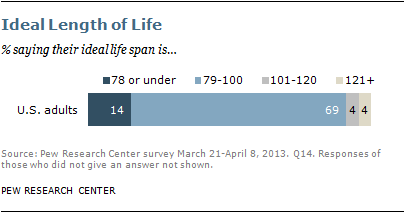
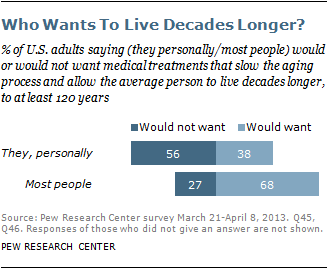
According to a detailed survey Pew Research Center conducted last year, comments of my in-laws are well represented in the mainstream of views across the US. As the following figures show, only 38% of people in the US would want to live to 120 and most Americans expect to live to between 85 to 90 years.

Figure 5-1

Figure 5-2

Only about 4% feel that ideal lifespan is between 100 and 120 and another 4% think it is over 120.

Figure 5-3

A majority of people think that living to 120 will be a bad thing for society.

Figure 5-4

A surprising result survey researchers noted is that most of these measures are fairly constant across various religions, gender, education or political party affiliations in America.

In my conversations, I have found that three reasons come up most often when people mull over if they personally want to live to 120:

  1. What would be the condition of their personal health? Will it be joyful living or a painful living?
  2. Will they have financial means to sustain themselves? Being broke is not much fun.
  3. Will their peers and loved ones be around? If not, will it be worth living?

As for myself personally, I feel that there are two major objectives of life: Growth and Contribution.

Thus my rationale for wanting to live to 120 is to simply maximize the time I have available to grow and contribute. Additionally, purposely living to 120, learning some things along the way, sharing with others as I learn, seem to fit in with my personal growth and contribution model of life.

In this sort of context, I see the three common objections cited above, as challenges to overcome as I pursue the goal of purposely living to 120. Moreover, not only I want to live to 120, but I wish to do it healthfully, purposefully and joyfully.

Looking at it another way, I feel, if it is okay to expect to get to 90 healthfully, purposefully and joyfully, why not to 120?

And, of course, as my mother-in-laws suspected, a key purpose for me to write this blog and engage in conversations with family, friends, loved ones is to motivate them and along the way find others who would want to share this journey together.

How do you feel about living to 120?

What do you think it would take to live to 120 healthfully, purposefully, and joyfully?

Please leave comments to this post. I and others following this blog would love to hear your perspective!

Post #4 – Is it even possible to live to 120? – Part II

Tags

, , , ,

In the last post on this topic, I concluded that

“As an optimist, when I look at this data, it looks very encouraging to me. First, it is definitely viable to live to 120. It has already been done! Like the four-minute mile, someone has already shown the way.

Second, an increasing number of people are approaching that age with an increasing rate. So, at this rate, I expect by the time my time arrives, dying at 120 will be as routine as dying at 100 today! It might not be very common, but it might not be that rare.”

While I make this informal and what seems like a rather obvious deduction from the data, some folks disagree.

James F. Fries and Lawrence M. Crapo in their book on Vitality and Aging make a compelling argument: while life expectancy has been increasing over the last many decades life-span has been fixed (for all practical purposes – increasing only by 0.1 year per century).

So, intuitively, the chart below may be how one would be tempted to guess the shape of life expectancy curves.

Figure 1
However, they argue, that it is the chart below that corresponds to the reality.

Figure 2

Thus according to their conclusion, while on an average humans are living longer and longer, we are still stuck at dying by the age of 100.

Presenting the data from another perspective in the chart below, as we graph number of deaths against age of death, we observe a normal or Gaussian distribution around certain age at which number of deaths peak. As the life expectancy keeps increasing the curve would look like the IDEAL curve below.

Figure 3

And, as that happens, graph of percent survial rate against age will become “rectanguar” as shown below.

Figure 4

This implies that as we conquer chronic diseases, we will live a healthy long life after which we will succumb very quickly to the forces of nature, within the bounds of a very few years. And, that will define an ideal “natural” death. As we hit certain time limit, all of the cells in the body may burst together like soap bubbles.

Fries and Crapo wrote their book in 1981. So I thought, with all the new research in the last 30+ years, maybe they have changed their mind.

In a more recent review article in the Journal of Aging Research, Compression of Morbidity 1980–2011: A Focused Review of Paradigms and Progress, James F. Fries, Bonnie Bruce, and Eliza Chakravarty reassert the same conclusion and buttress it with more recent studies.

I really like most everything else they assert, derive or conclude in that book- which I would like to talk about in a different post. However, I am personally not sold on this idea of fixed life-span.

It makes me quite uncomfortable. Yeah, you guessed it. After all, my goal is to purposely live to 120!

What do you think?

Have you seen any data, studies or analysis that contradicts this theory about fixed life-span?

Post #3 – Is it even possible to live to 120?

Tags

, , , ,

When I bring it up to friends and family members that I am planning to live to 120 years, the kinds of questions and/or comments I get are:

“Wow, that is pretty gutsy to think that you can live to 120.”

“Why do you want to live that long?”

“I would probably not be around past 85.”

“I would not want to be around that long. It would be no fun. All
my contemporaries would all be gone.”

“My money won’t last that long.”

“What is the longest any one has lived?”

“How many people have lived over 100, 110, or 115?”

As I started wondering about these, I thought maybe I would start from the bottom of the list. Those questions certainly look easier.

So, what is the recent record of longevity for humans?

Wikipedia has some real good pages summarizing this information, for example, you can start with Oldest People and  Super Centenarian.

1500 supercentenarians (those over 110) have been documented in history. There are 30 verified over 115 year olds.

The oldest ever lived was Jeanne Calment from France who died on 4 August 1997 at the age of 122 years, 164 days. Sarah Knauss from the United States came closest to 120; she died on 30 December 1999 at the age of 119 years and 97 days. Two died at 117 years, and five at 116 years.

The oldest currently living is Misao Okawa in Japan at the age of 116 years and 11 days. She is the 10th oldest so far.

In 2012, the UN estimated there to be 316,600 centenarians (over 100) living worldwide. The US has the highest number (53,364 per the 2010 Centenarian Special Report ). Per the report:

“In the period from 1980 to 2010, the centenarian population experienced a larger percentage increase than did the total population. The number of centenarians increased from 32,194 to 53,364, resulting in a 65.8% increase, while the total population increased 36.3 percent. Consequently, the centenarian population increased from 1.42 per 10,000 in 1980 to 1.73 per 10,000 in 2010.”

As an optimist, when I look at this data, it looks very encouraging to me. First, it is definitely viable to live to 120. It has already been done! Like the four-minute mile, someone has already shown the way.

Second, an increasing number of people are approaching that age with an increasing rate. So, at this rate, by the time my time arrives, dying at 120 will be as routine as dying at 100 today! It might not be very common, but it might not be that rare.

What do you think? How do you see these statistics?

Post #2 – So, how do we die?

Tags

, , ,

So, how do people die?

Setting aside the very first question for now, i.e. what is the object of this game

of life? – which can be an interesting trip down the rabbit hole.

Let us ponder on how do people die?

First, the simple answer: I just look up the World Health Organization (WHO) statistics or US Department of Health and Human Services (HHS) data and listed there are the leading causes of death. Of course, the causes vary by demographics.

In 2010, the latest year for which we have complete statistics in the US, 2,468,435 people died. Here are deaths from all the causes and the number and percent from each cause:
1. 597,689 24.2% Diseases of the Heart (heart disease)
2. 574,743 23.3% Malignant neoplasm (cancer)
3. 138,080 5.6% Chronic lower respiratory disease
4. 129,476 5.2% Cerebrovascular diseases (stroke)
5. 120,859 5.2% Accidents (unintentional injuries)
6. 83,494 3.4% Alzheimer’s disease
7. 83,494 2.8% Diabetes Mellitus (diabetes)
8. 50,476 2.0% Nephritis, nephrotic syndrome and nephrosis (kidney disease)
9. 50,097 2.0% Influenza and pneumonia
10. 38,364 1.6% Intentional self-harm (suicide)
11. 34,812 1.4% Septicemia (blood infection)
12. 31,903 1.3% Cirrhosis (liver disease)
13. 26,634 1.1% Hypertension & hypertensive diseases (high blood pressure)
14. 22,032 0.9% Parkinson’s disease
15. 17,011 0.7% Pneumonitis due to solids and liquids
16. 438,694 19.6% All other causes ( including “natural causes”)

So, there you have it!

Except, that this data begs several questions,

First, what are “All other causes”? That category is large enough to be the third largest cause of death.

Some of these causes show up when we look at the top mortality causes for low income nations: HIV/AIDS, malaria, diarrhea, tuberculosis, all causes of infant mortality, malnutrition, cholera, meningitis, sexually transmitted infection, etc.

I still have not found a good source of raw data for the US, so I can comb through all causes. After all, it would be useful to know all reasons, when shooting for longevity. Do you have a good source of such data?

Second, what does it mean to die of “old age” or of “natural causes”?

One common answer I have seen cited repeatedly is that all old age (or “natural”) deaths are really caused by traumatic events (may be from the above list) that prove fatal due to body’s inability to recover,

Does someone have another answer to this question?

Post #1 – Questions I have been pondering lately..

Tags

, , , , ,

May be it is because I am turning 60 this year or may be it is something else… These are the questions I have been pondering lately:
• What is the object of this game of life?
• How do people die?
• How do people lose vitality?
• What would it take to have a life-span and a health-span of 120?
• How do I want to live the next 60 years of my life?
• How do I contribute at a level that is worthy of my life?
• How do I make a major contribution to preventative healthcare – the area that gets my juices flowing?

In finding answers to these questions, I have been reading whatever I can lay my hands on and talking to whoever would talk to me on this topic.

One of my recent thoughts has been to may be to find other kindred spirits – people who are searching for answers to these or similar questions – and may have even already found some answers!

Also, I am going to use this blog to reflect upon what I come across. Through these reflections I would like to share what I have learned and learn from others.

So, I would love to hear your comments:

Are you in pursuit of a goal to live to 120?

Do you wonder what it might take to purposely live a life of vigor to the age of 120?